Cricket id KYC verification is the point where a betting platform stops treating you as an anonymous username and asks you to prove who you are with real documents. Most explainers on this subject are written for crypto casinos, not for the WhatsApp-driven cricket ID world, where the process looks different and the risk of sharing documents is higher. This breakdown covers why documents are requested, how the submit-review-confirm flow works, why checks fail, and when the request itself is the warning sign.
Table of Contents
What Cricket ID KYC Verification Actually Means
KYC stands for Know Your Customer. In banking and payments it is a standard identity check: the institution collects a document, compares it against the account details, and confirms the person behind the account is real. Betting platforms borrowed the same idea, and cricket ID operations borrowed it from them, with varying degrees of seriousness.
On a conventional betting app, cricket id KYC verification usually happens inside the app itself. You photograph a document, upload it through a form, and an automated system or a human reviewer approves or rejects it. On agent-run cricket IDs the process is often informal: someone asks for a photo of your ID over WhatsApp, with no form, no portal, and no record of where the image goes.
That difference matters more than any other detail here. A structured upload inside an app can still go wrong, but a document sent to a personal chat number has left your control entirely.
One framing note before the detail. Everything an identity check protects sits on top of games where outcomes are chance and the operator keeps a built-in house edge. Verification can confirm who you are; it cannot shift the odds, and real money remains at risk throughout. This article is written for adults 18+ who want to understand the mechanics.
Why Do Betting Platforms Ask for KYC Documents?
Platforms give several reasons for requesting documents, and most of them are ordinary business motives rather than favours to the user. Understanding them helps you judge whether a specific request is proportionate or excessive.
- Age confirmation. Real-money play is for adults, and a date of birth on a government document is the only practical way a remote platform can check it.
- One person, one account. Duplicate accounts are used to abuse bonuses and manipulate promotions, so operators match documents against existing records.
- Payment matching. Operators generally want the name on the withdrawal method to match the name on the account, which they can only confirm against a document.
- Fraud and chargeback control. Verified identities make it harder to use stolen payment credentials or dispute deposits afterwards.
- Money-flow monitoring. Payment processors and banks expect the businesses they serve to know who their customers are.
Notice what is absent from that list: nothing about protecting your winnings. Identity checks primarily protect the operator and its payment channels. They can incidentally protect you, since a verified account is harder for a stranger to hijack, but that is a side effect rather than the purpose.
The timing of a request is also informative. Established platforms tend to ask early, often before or shortly after the first deposit, because an unverified customer is a liability to them. A platform that ignores identity entirely while you deposit, then demands documents the moment you request a payout, is using verification as a delay mechanism rather than a control. That pattern runs through the rejection and withdrawal sections below.
Documents Usually Requested for Verification
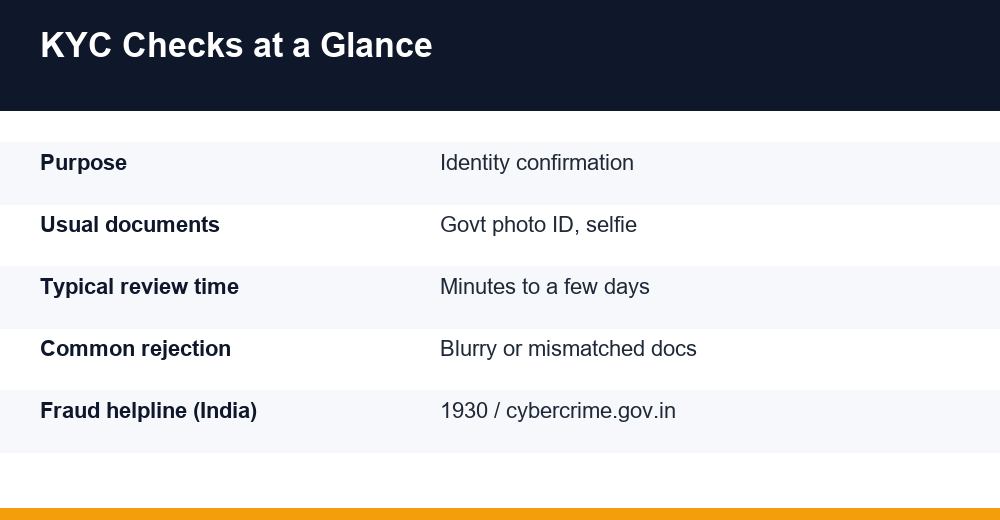
Requests vary by platform, but identity checks across industries follow the same two-category structure: proof of identity and proof of address. A photo ID issued by a government authority covers the first; a document showing your name at a current address covers the second. Some platforms add a third layer tied to the payment method.
- Identity proof: a government-issued photo ID, typically Aadhaar, PAN card, passport, driving licence or voter ID in India.
- Address proof: a utility bill, bank statement, or an ID that carries the address, usually dated within the last few months.
- Selfie or liveness check: a photo of your face, sometimes holding the ID, to show the document belongs to the person submitting it.
- Payment proof: an image of the UPI handle, bank passbook page or card, with sensitive digits masked, used for deposits and payouts.
A reasonable platform asks for the minimum it needs: one identity document plus, at most, one address or payment proof. Requests that stack PAN and Aadhaar and passport and a bank statement and a video call collect far more data than any check requires.
Why Document Minimalism Matters
Each document you hand over is a copy you can never recall. A platform that asks for one ID can lose one ID; a platform that collects four can lose a complete identity package in a single bundle, which is exactly the set an impersonator needs. The volume of data collected is a risk measure in its own right, independent of whether the operator is honest.
If you have not yet created an account and want to see where document requests appear in the onboarding sequence, the cricket ID setup walkthrough maps each stage, including the points where personal data is collected.
The Submit-Review-Confirm Flow, Step by Step
On platforms with a formal process, cricket id KYC verification follows a predictable three-stage flow. Knowing the stages helps you tell an ordinary queue from a deliberate stall.
- Submit. You upload document images through the app or site, usually on a dedicated verification page inside the account or profile section. Formats are typically JPG, PNG or PDF, with a file-size cap.
- Review. Automated software reads the document first, checking that text is legible, the photo matches the selfie, and the details match your registration. Edge cases are passed to a human reviewer.
- Confirm. You receive an approved, rejected or resubmit-requested status, usually by in-app notification, SMS or email. Approval unlocks whatever the platform gated behind the check, most often withdrawals.
| Stage | What happens | Illustrative time | What you should see |
|---|---|---|---|
| Submit | Documents uploaded via form | Minutes | Upload confirmation on screen |
| Automated review | Software reads and matches data | Minutes to hours | Status shows pending or in review |
| Manual review | Human checks flagged cases | Hours to a few days | Same pending status, longer wait |
| Confirm | Decision issued | Immediate once decided | Approved, rejected or resubmit |
The times in that table are illustrative rather than promises, and real queues move at the speed of whatever staffing sits behind them. The structural point is that each stage should produce something you can see: a confirmation, a status, a decision with a reason attached. A process with no status page, no reference number and no written outcome gives you nothing to hold anyone to later.
Keep your own records regardless of how smooth the process looks. Screenshot the upload confirmation, note the date, and save any status messages or reference numbers. If a dispute arises weeks later, that timeline is the only evidence you control.
Why Was My KYC Rejected? Common Causes
Most failed attempts at cricket id KYC verification trace back to a short list of fixable problems. The recurring causes are image quality and data mismatch: the document is fine, but what the system reads does not line up with what you typed at registration.
- Blurry, dark or glary photos the software cannot read, which is the single most common cause.
- Cropped edges or covered corners, since reviewers are told to reject documents that are not fully visible.
- Name mismatch between document and account: a missing middle name, a different spelling, or a nickname used at signup.
- Expired documents, which fail validity checks automatically with no human involvement.
- Wrong details at registration, such as a date of birth entered incorrectly months earlier.
- Screenshots or scans of photocopies, which some systems reject in favour of a direct photo of the original.
- Edited images, where any sign of alteration, including innocent cropping or filters, can trigger a fraud flag.
The fix is usually mechanical. Retake the photo in even light on a flat surface, include all four corners, avoid flash glare on laminated cards, and make the account name match the document exactly, character for character. If the platform allows edits, correct the registration details before resubmitting rather than hoping a reviewer overlooks the gap.
Legitimate Rejection Versus Stalling
A legitimate rejection comes with a reason, such as blurry image, name mismatch or expired document, and an invitation to resubmit. Treat a rejection that arrives with no reason at all, or a loop where every resubmission fails on a new unstated ground while your balance sits frozen, as a different phenomenon. At that point the question is no longer how to pass the check but whether the platform intends to pay at all.
Can You Withdraw Without Completing KYC?
On most structured platforms, no, and that is by design. Deposits are often accepted with minimal checks, while the withdrawal button is where verification becomes mandatory. Some platforms let small payouts through unverified and require documents above a threshold; many require cricket id KYC verification before the first withdrawal of any size.
This asymmetry, easy money in and verified money out, is worth sitting with. It means the platform holds your funds at the exact moment it gains leverage over you. An honest operator uses that moment to run a real check and then pays. A dishonest one uses it to manufacture delay: documents are requested, rejected, re-requested, and the payout never arrives.
Agent-run cricket IDs add another layer. There may be no formal check at all, just an individual’s discretion over whether and when to transfer winnings. The absence of a verification step is not a convenience; it reflects the absence of any process you could point to when a payment is refused. How payouts actually move in that arrangement is covered in the cricket ID withdrawal breakdown.
Colour-prediction apps repeat the same pattern with their own quirks: recharge-style deposits, task thresholds, and payout queues that lengthen as an app nears the end of its life. The colour-prediction withdrawal process post walks through those stages and the stalling behaviour specific to that format.
The practical takeaway is about sequencing. If you ever intend to withdraw, complete whatever verification exists before any meaningful money sits on the platform. Discovering a document wall while a large balance is locked behind it is the worst possible order of events.
Is It Safe to Upload Identity Documents? Red Flags
Here is the uncomfortable part most explainers skip: sometimes a cricket id KYC verification request is itself the harm. An Aadhaar, PAN or passport image is valuable data. In the wrong hands it feeds SIM-swap attempts, credit applications in someone else’s name and convincing impersonation. Unlike a lost deposit, leaked identity documents cannot be clawed back.
The real question is who receives the image and what becomes of it. Some situations shift the answer decisively toward not sending anything at all.
- Documents requested over WhatsApp or Telegram to a personal number rather than through an in-app upload form.
- No published privacy policy, or no statement anywhere of how documents are stored and for how long.
- Escalating demands: first one ID, then a second, then a selfie holding it, then a video call, especially after a withdrawal request.
- Requests for live credentials alongside documents, such as OTPs, UPI PINs or banking passwords. No verification process ever needs these.
- A surprise fee to process or unlock verification. Paying to release your own money is a classic advance-fee pattern.
- Pressure and deadlines, such as verify within an hour or the account closes, designed to stop you thinking.
If documents have already gone to someone who then froze your funds or demanded fees, record everything you have: chat logs, payment receipts, transaction IDs and the numbers involved. In India, financial cyber fraud can be reported on the government’s National Cyber Crime Reporting Portal or by calling the helpline 1930. Speed matters, because the response works by trying to block money while it is still moving between accounts.
After a call to 1930 the complaint still has to be completed on the portal, so keep the bank or wallet name, transaction ID, date and amount to hand. Alert your bank in parallel, and never share an OTP with anyone claiming to be from the police, a platform or a helpline.
And if chasing locked money is spilling into sleep, work or family life, support exists beyond fraud reporting. India’s Tele-MANAS mental-health helpline on 14416 is free, available around the clock and staffed in multiple languages.
5 Essential Checks Before You Verify
Pulling the whole article into a working checklist: run these five checks before any cricket id KYC verification request gets a single document from you.
- Check the channel. Is there a proper in-app upload form with a status page, or is someone asking for photos in a chat? A form is the minimum; a chat request fails the test outright.
- Check the scope. Are they asking for one identity document and perhaps one supporting proof, or stacking every document you own? Minimal requests are normal; maximal ones are data harvesting.
- Check for credential requests. Documents are one thing; OTPs, PINs and passwords are another. Any process that wants live credentials is not a verification process.
- Check the cost. Genuine verification is free. A fee to verify, unlock or release funds is an advance-fee demand wearing a compliance costume.
- Check the paper trail. Will you get a written status and a stated reason for any rejection? If the outcome lives only in someone’s chat messages, you have no process, only a promise.
A request that passes all five can still belong to a platform that later stalls a payout. Verification is one safeguard, not a guarantee. But a request that fails even one of the five has told you something useful before you risked anything, and the cheapest moment to walk away is always before documents leave your phone.
Keep the wider frame in view as well. Identity checks decide whether money can move in and out of an account; they say nothing about whether the games behind it are worth playing. Outcomes remain chance with the margin tilted to the house, real funds are at risk, and no verified badge changes that arithmetic.
Frequently Asked Questions
Why do betting platforms ask for KYC documents?
Mainly to protect themselves: confirming users are adults, blocking duplicate accounts used for bonus abuse, matching withdrawal methods to the account holder’s name, and controlling fraud and chargebacks. Payment processors also expect operators to know their customers. Identity checks incidentally make account hijacking harder, but the primary beneficiaries are the operator and its payment channels, not the player.
Why was my KYC rejected?
Most rejections come from fixable problems: blurry or glary photos, cropped corners, expired documents, screenshots instead of direct photos, or a name mismatch between document and registration details. Retake the image in even light with all corners visible and make account details match the ID exactly. A rejection with no stated reason, repeated while funds stay frozen, is a stalling pattern rather than a quality issue.
Can I withdraw without completing KYC?
Usually not. Many platforms accept deposits with minimal checks but require verification before a first withdrawal, or above a payout threshold. That asymmetry hands the platform leverage precisely when you want money out. If any verification step exists, complete it before building a balance, so you never discover the document wall with significant funds locked behind it.
Is it safe to upload identity documents to a betting app?
It carries real risk. Leaked Aadhaar, PAN or passport images can feed impersonation and fraud, and cannot be recalled once copied. Refuse requests made over personal WhatsApp numbers, demands for OTPs or PINs, fees to verify, and escalating document lists. If documents were misused or funds frozen afterwards, report it at cybercrime.gov.in or by calling 1930 in India.