The colour prediction withdrawal process confuses more players than the games themselves, and most pages that rank for it are app-specific promotion rather than a plain explanation of what happens to your money. This breakdown walks through the generic pipeline — request, checks, processing, payout, confirmation — so you can read each status correctly before you panic or redeposit. One honest note up front: outcomes in these games are chance with a built-in house edge, real money is at risk, and everything here is written for adults aged 18 and over.
Table of Contents
How the Colour Prediction Withdrawal Process Actually Works
A withdrawal is not one event. It is a chain of hand-offs: the app’s internal wallet, the platform’s payment processor, and finally the banking rails that carry money to your account. When a payout feels stuck, it is almost always sitting at one of these hand-off points, and each point shows a different status inside the app.
The platform does not move money the way a bank does. It collects payout requests, runs its own checks, groups approved ones into batches, and only then instructs a payment partner to transfer funds by UPI or bank transfer. Your bank is involved at the very last step only. That is why an app can display a payout as complete while your account still shows nothing — and why the reference number attached to the final transfer matters far more than the status label.
Everything below describes the generic pipeline most apps follow, not any single platform, and names no app on purpose. The same basic flow also applies to a cricket ID withdrawal, where an agent or intermediary wallet can add one more hand-off to the chain and therefore one more place for money to pause.
Wallet Balance Versus Withdrawable Balance
Before any status makes sense, work out which part of your balance can actually leave the platform. The colour prediction withdrawal process only ever touches the withdrawable portion, and that figure is rarely the big number on the home screen.
Most apps split a wallet into several buckets with different rules. The split is not a trick in itself — it is standard practice wherever promotional credit exists — but it is the single commonest reason a request for “my balance” is refused within seconds.
| Balance type | What it usually represents | Withdrawable? |
|---|---|---|
| Deposited funds | Money you added yourself | Often yes, sometimes after play |
| Settled winnings | Credited from completed rounds | Usually yes |
| Bonus credit | Promotional credit from the app | No, until conditions are met |
| Locked or held amount | Tied to an open request or review | Not until released |
| Referral or task credit | Credited for in-app activity | Varies; often conditioned |
The condition attached to bonus credit is usually a turnover requirement: the bonus, or some multiple of it, must be staked before anything linked to it becomes withdrawable. Read that multiple before you accept any credit, because it decides how much play stands between you and a payout. It also means promotional credit is not money in any practical sense until the condition is cleared, and most of it never is.
The 7 Steps From Request to Bank Credit
Here is the full colour prediction withdrawal process laid out as a sequence. Knowing which step you are on tells you who is holding your money at that moment — the platform, its payment partner, or a bank.
- Request — you enter an amount and confirm the bank account or UPI ID on file. The amount leaves your usable wallet immediately and sits in a pending state.
- Eligibility check — automated rules fire first: minimum amount met, turnover conditions cleared, no duplicate request already open, account not flagged.
- Verification review — on a first withdrawal, or an unusually large one, an automated or human review compares your payout name against your registered identity details.
- Processing — the approved request joins a payout batch and is handed to the platform’s payment partner along with your account details.
- Transfer — the payment partner pushes the money through UPI or bank transfer. This step is what generates a unique transaction reference.
- Bank credit — your bank receives and credits the amount. Bank-side downtime, holidays and technical queues sit at this step, outside the platform’s control.
- Confirmation — the app marks the request complete and, ideally, shows the transaction reference you can match against your bank statement.
Steps one to four happen inside the platform and are where nearly all long delays live. Steps five to seven involve real banking infrastructure, which in India is generally quick once a transfer has genuinely been initiated. If a payout is days old, the probability that a bank is responsible is low.
Reading Each Status: Pending, Processing, Rejected
Apps use slightly different labels, but nearly all statuses map onto the same few underlying states. This table translates them, along with the response that actually helps.
| Status shown | What it usually means | Sensible response |
|---|---|---|
| Pending | Request logged, checks not finished | Wait; do not submit a duplicate |
| Under review | Manual verification in progress | Check your documents and name details |
| Processing | Approved, sent to payment partner | Note the time; ask for a reference |
| Completed | Transfer initiated or finished | Match the reference in your bank app |
| Rejected | A check failed; money returned to wallet | Read the stated reason before retrying |
| Failed | Transfer bounced at the bank | Verify account details, then retry once |
Why is a withdrawal still showing as pending?
A long pending status usually means the request has not cleared the platform’s internal checks: unmet turnover on bonus-linked funds, a name mismatch, incomplete verification, or simply a manual review backlog. What pending never requires is another deposit. Any app that asks you to pay money in order to release money is describing a classic fraud pattern, not a payout rule.
Submitting repeat requests while one is open tends to make things worse, because duplicates can trigger exactly the automated flags that push an account into manual review. One request, then the platform’s own stated window, then escalation — in that order.
Verification Holds Before a First Payout
Most platforms let you deposit with almost no checks but verify you before paying out. However one-sided that feels, the mechanics are consistent across the category: the first withdrawal is where identity, age and account-ownership checks are enforced.
Do you need to complete verification before withdrawing?
On most platforms, yes — at least once. A typical flow asks you to submit an identity document and sometimes a bank proof, waits for review, and only then opens the payout queue for your account. Until that happens, requests either sit in review or are declined automatically. What gets checked, and why submissions fail, is covered in our separate explainer on cricket ID KYC verification, and the same logic applies to prediction apps.
The single biggest verification trap is the name mismatch. If the name on your platform profile, your identity document and your bank or UPI account do not match closely, the payout check fails — sometimes over a spelling difference, an initial, or a missing surname. Paying out to someone else’s account is blocked by the same check on most platforms, so an account borrowed from a friend or relative is a dead end by design.
- Register with the exact name printed on your bank account, not a nickname or a short form.
- Withdraw only to an account you own; third-party payouts are routinely refused.
- Finish document checks before you need money out, not on the day you want it.
- If a document is rejected, fix the specific reason given rather than resubmitting the same file.
- Keep one registered mobile number and one payout account; frequent changes trigger fresh reviews.
One caution on the other side of this. Verification asks for sensitive documents, so check what you are uploading and where. Sharing a document is normal; sharing a one-time password, a UPI PIN or screen access with support staff is not, and no genuine verification step needs any of the three.
Minimum Withdrawal Amounts and Why They Exist
Almost every prediction app enforces a minimum payout. Figures in the ₹100 to ₹500 range are commonly reported across the category, though the exact number varies by platform and these are illustrative rather than universal. Maximum daily limits and a capped number of free withdrawals per day are widespread too.
The stated reason is cost: every transfer carries a processing fee, so platforms batch small balances into fewer, larger payouts. The unstated reason matters more to you as a user. A minimum keeps small balances sitting on the platform, where the whole design nudges you to play them rather than cash them out. Recognising that nudge is half the battle, because every further round carries the same house edge as the first.
A few patterns around minimums are worth watching closely. A platform that raises its minimum after you win, adds a fee between your request and the payout, or introduces a new “tier” requirement once your balance grows is changing the rules mid-game. Genuine cost recovery is disclosed up front, in fixed terms, and applies to everyone — it is not invented in response to one account’s balance.
How Long a Payout Takes to Reach the Bank
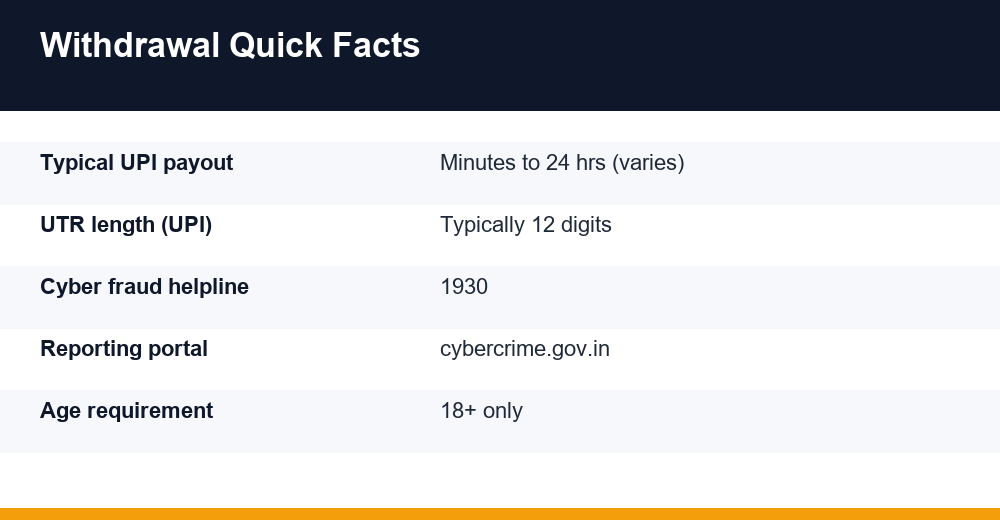
There is no single honest number here, because the colour prediction withdrawal process runs two clocks at once: platform time and bank time. Platform time — approval plus processing — ranges from minutes to several days depending on review queues. Bank time is short: UPI transfers in India are built to be near-instant once initiated, and ordinary bank transfers typically land the same day.
| Stage | Typical range (illustrative) | Who controls it |
|---|---|---|
| Internal approval | Minutes to 48 hours | Platform |
| Payout batch to partner | Minutes to 24 hours | Platform / processor |
| UPI transfer | Seconds to minutes | Banking rails |
| Bank transfer (non-UPI) | Same day to 1–2 working days | Banks |
| Failed transfer auto-return | Commonly 1–5 working days | Banks |
The decisive piece of evidence at the transfer stage is the UTR, the unique transaction reference generated when money actually moves. For UPI it is usually a 12-digit number, visible in the transaction details of your payment app or on your bank statement. If a platform says it has paid you, ask for that reference: a payment that genuinely happened has one, and your bank can trace it. How to find and use it is covered in our explainer on the UTR number in betting.
The reference is not a technicality. India’s own cyber fraud reporting form asks complainants for the 12-digit transaction ID or UTR number precisely because it is the thread that lets anyone follow the money. If support cannot produce one days after marking a payout complete, treat the claim as unverified — a completed status without a traceable reference is a label, not a payment.
Why Withdrawals Get Rejected: The Usual Causes
A rejection feels alarming, but in most cases the money returns to your wallet and the cause is mechanical. These are the usual culprits, roughly in the order they show up in user complaints.
- Name mismatch between the platform profile and the receiving bank or UPI account.
- Unmet turnover conditions — the requested amount included bonus-linked funds that were not yet withdrawable.
- Incomplete, unreadable or expired verification documents.
- Wrong or inactive account details: a typo in the account number, a closed account, a changed UPI ID.
- Duplicate requests submitted while an earlier one was still open.
- An amount outside the allowed minimum or maximum for your account tier.
- Risk flags inside the platform’s own system, which usually trigger manual review rather than instant rejection.
Read the reason the app gives, fix that one thing, and retry once. If rejections continue with no stated reason — or the reason keeps changing — stop depositing and shift to evidence-gathering, because a platform that can always find a new reason not to pay is showing you its real policy.
One pattern deserves its own warning. Small withdrawals succeed, then a larger one is rejected or frozen with a demand for a tax, an unlock fee, a “server charge” or a verification deposit. Paying that has one reliable outcome: a second loss on top of the first. No genuine payout anywhere requires you to send money first, and a refusal that arrives with a payment request should be read as the end of the relationship rather than a hurdle.
Checklist Before You Raise a Payout Complaint
Before escalating anything, make sure the problem is not on your side of the table, then build a file that lets anyone — platform support, your bank, or a fraud reporting channel — act quickly. Work through this list in order.
- Confirm the receiving account details character by character, including the UPI handle.
- Check that your verification status reads complete and that your payout name matches your bank name.
- Confirm the conditions: was the requested amount fully withdrawable, or partly bonus-linked?
- Allow the platform’s own stated processing window to pass once — but only once.
- Screenshot everything: the wallet breakdown, the request, its status history, and the stated timelines.
- Export your chat with support, and ask directly for the UTR of any payment they claim was made.
- Note the platform’s exact web address and app version, since prediction platforms frequently rebrand or switch domains.
If a platform will not pay, will not respond, or demands extra payments to release your balance, treat it as a financial fraud situation rather than a customer-service dispute. In India the cyber fraud helpline is 1930, and speed matters, because funds that have not yet moved on can sometimes be held.
The official citizen instructions for reporting financial cyber fraud ask you to register the complaint on the national reporting portal within 24 hours of getting the acknowledgement number from the helpline, with your evidence attached. Tell your own bank or UPI provider too, so the trail is flagged from both ends.
Finally, a word beyond process. If chasing a blocked balance has you depositing more than you can afford to lose, that is the moment to stop entirely rather than the moment to try once more. These games are chance with the odds tilted against the player by design, they are for adults aged 18 and over, and free support for gambling-related stress and anxiety is available in India through the government’s Tele-MANAS helpline on 14416.
Frequently Asked Questions
Why is my colour prediction withdrawal pending?
A pending status means your request has not cleared the platform’s internal checks yet: unmet turnover on bonus funds, a name mismatch, incomplete verification, or a manual review backlog. Wait out the stated window once, without submitting duplicates. If pending stretches on with no reason given, collect screenshots and escalate rather than depositing more, because no genuine payout ever needs a fresh deposit first.
How long does a colour prediction withdrawal take to reach the bank?
Two clocks run in the colour prediction withdrawal process: platform approval, which ranges from minutes to a couple of days, and the transfer itself, which is near-instant on UPI and usually same-day otherwise. Those figures vary by platform and are illustrative. Once a transfer is genuinely initiated it carries a reference number, usually 12 digits on UPI; if support cannot produce one, the payment probably has not happened.
Why was my withdrawal rejected?
The commonest causes are mechanical: the name on your bank or UPI account not matching your profile, bonus-linked funds that were not yet withdrawable, incomplete verification documents, wrong account details, or duplicate requests. The money normally returns to your wallet. Fix the stated reason and retry once. Repeated rejections with shifting or missing reasons are a red flag worth documenting rather than retrying.
Do I need to complete verification before withdrawing?
On most platforms, yes, at least before your first payout. Deposits are usually frictionless, but withdrawals trigger identity, age and account-ownership checks. Expect to submit an identity document, wait for review, and make sure your registered name matches your bank account name exactly. Completing this before you need money out prevents the commonest hold of all, the name mismatch.