The phrase colour prediction algorithm is searched thousands of times a month by people who want to know whether red-green-violet games are random, rigged, or beatable. This explainer walks through how these result engines actually work, why streaks feel suspicious but usually are not, and why every “predictor” app sold online rests on a false premise. It is written for adults aged 18 and over, with no hacks, no tips and no sales pitch.
Table of Contents
What a Colour Prediction Algorithm Actually Is
Strip away the flashing timers and the result-history charts, and a colour prediction algorithm is a small piece of server software that does one job: pick an outcome for each round. In most of these games that outcome is a number from 0 to 9, which the platform then maps to a colour – typically red, green or violet – and sometimes to a size category such as big or small.
The player never interacts with that software directly. You see a countdown, you place a stake, the timer hits zero, and the server reveals a result it generated on its own machine. Everything that matters happens on the server side, out of sight of your phone. The full round sequence is broken down step by step in how prediction rounds really work.
Three points are worth fixing in mind before going any further:
- The result engine runs on the operator’s server, not on your handset – your device only displays what it is told to display.
- The mapping from numbers to colours, and the payout attached to each colour, is chosen by the operator. That part is a design decision, not chance.
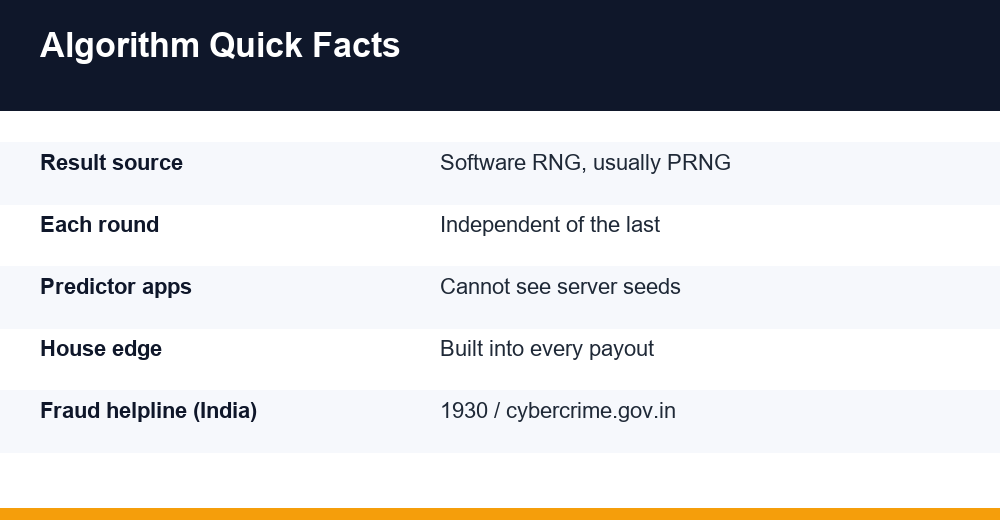
- Payouts are set below the true odds of each outcome, which is how a built-in house edge works: over many rounds the game keeps a margin no matter who wins any single round.
That last point matters more than any technical detail. Even a perfectly random game is arranged so that money flows toward the operator over time. Real money is at risk every time a stake is placed, and these products are for adults aged 18 and over only.
Random or Fixed: What Players Can Actually Know
The most common question is whether the game is genuinely random or secretly fixed. The honest answer is uncomfortable: from the outside, you cannot tell. A fair generator and a manipulated one can produce result histories that look identical across the few hundred rounds any individual player ever sees.
Independently audited gaming software is tested by third-party laboratories that run statistical batteries over millions of outputs and publish a certificate naming the lab, the software build and the test date. Most colour-prediction platforms publish nothing of the kind: no audit report, no named testing laboratory, no description of the software. Security researchers studying these apps have repeatedly documented clusters of near-identical platforms promoted through social media, a number of which later stopped paying users altogether.
So the realistic position is this. Some platforms may run honest random software and others may not, and nothing visible on screen separates the two. A long green streak is not proof of rigging, and a smooth payout history is not proof of fairness. Where there is no published audit, trust is being requested rather than earned – and even an honest draw leaves the payout margin working for the operator.
Do Prediction Games Use a Random Number Generator?
Yes. Virtually every digital game of chance, from licensed slot software to the smallest wingo clone, relies on a random number generator (RNG). But the word “random” needs unpacking, because an ordinary computer cannot produce true randomness on its own.
Pseudo-random, not truly random
What almost all software uses is a pseudo-random number generator (PRNG). A PRNG is a deterministic formula: it starts from an initial value called a seed, then applies mathematical operations to churn out a long sequence of numbers that passes statistical tests for randomness. Feed in the same seed and a PRNG produces exactly the same sequence every time. That is what “pseudo” means.
Well-built PRNGs – the widely studied Mersenne Twister family, or modern cryptographically secure generators – produce sequences so long and so evenly distributed that no player could exploit them in practice. Some systems also mix in hardware entropy, such as timing noise, when choosing the seed. The real quality question is never “is a PRNG used?” but which generator, how it is seeded, and whether anyone independent has inspected the implementation.
| Term | What it means | Why it matters to a player |
|---|---|---|
| PRNG | Formula-driven generator from a seed | Predictable only if the seed and state are known |
| Seed | Starting value for the sequence | Held in server memory, never shown to players |
| CSPRNG | Cryptographically secure generator | Past outputs reveal nothing about future ones |
| Independence | Each round drawn separately | No colour is ever “due” after a streak |
Where the colour prediction algorithm fits in
In a typical round the server requests a value from its generator when the timer closes, maps that value to a digit and a colour, and publishes the result. A colour prediction algorithm is essentially this mapping layer sitting on top of a PRNG. If the generator is sound and the operator does not interfere, each outcome is statistically independent of every outcome before it. The countdown itself is only scheduling, as set out in wingo round timers explained; the clock has no influence on which colour appears.
Why Long Losing Streaks Happen in Colour Games
Losing seven or eight rounds in a row feels like proof that something is wrong. In reality, streaks are one of the most ordinary features of random sequences – and one of the least intuitive.
Suppose a bet loses slightly more often than it wins, which is the case once the house margin is included: the chance of any single loss might sit somewhere around 52 to 55 per cent. Chain several independent rounds together and streaks stop being rare at all. The table below uses a simplified 50 per cent loss chance per round purely as an illustrative example; real games are tilted further against the player, so the true figures are slightly worse.
| Consecutive losses | Chance from any starting round (illustrative, 50% per round) | How it tends to feel |
|---|---|---|
| 3 in a row | 1 in 8 (12.5%) | Mildly annoying |
| 5 in a row | 1 in 32 (about 3.1%) | Suspicious |
| 7 in a row | 1 in 128 (about 0.8%) | “The game is rigged” |
| 10 in a row | 1 in 1,024 (about 0.1%) | “Someone is targeting me” |
A 1-in-128 event sounds rare, yet a player who sits through 500 rounds in a week hands that event hundreds of opportunities to appear. Across thousands of players it happens to somebody every single day, and that person almost always concludes the game is fixed rather than that they met an expected pattern.
The mirror image of this error is the gambler’s fallacy: the belief that after five reds, green is somehow “due”. If rounds are independent, the next result carries exactly the same probabilities as the first. The sequence has no memory of what came before it.
This is where the misunderstanding becomes expensive. Chasing a “due” colour with larger stakes turns a normal streak into a serious loss, because the stake compounds while the odds stay exactly where they were. Doubling after each loss accelerates it further, and the table limit usually stops the recovery before the streak does.
Can a Colour Prediction Algorithm Be Hacked or Predicted?
Search results are full of videos and messaging-app channels claiming to have “cracked” the algorithm. It is worth spelling out what predicting outcomes would actually require, and why none of it sits within reach of a player.
- Knowing the exact generator. You would need to know precisely which PRNG the server runs, and in which configuration – information no operator publishes.
- Knowing the current seed and internal state. A PRNG’s output is only foreseeable if you know its state. That state lives in server memory. Cryptographically secure generators are designed so that even observing a long run of outputs does not reveal it.
- Knowing when and how the server samples it. Servers draw values continuously for many unrelated processes, so matching one draw to one game round from the outside is not feasible.
In short, predicting a properly implemented generator from the player’s side is not a skill problem. It is an information problem, and the information is not in the building. Nothing visible in the app – result history, timing, your own balance – carries any trace of the generator’s state.
There is also a simple logic test that settles most of these claims without any mathematics. A working prediction method would be worth an enormous amount to its owner and would stop working the moment it spread widely. Anyone with genuine access to an operator’s internal state would have no reason at all to sell it to strangers for a few hundred rupees. The fact that “hacks” are advertised cheaply and publicly tells you what they are.
Predictor Apps and Pattern Sellers: Red Flags
“Hack” apps, VIP prediction groups and pattern charts form an industry of their own. They share a single structural flaw: they claim to predict the output of a system whose internals they cannot observe. A colour prediction algorithm runs on a private server, while an app on your phone has no access to its seed, its state or its code.
The recurring warning signs below are worth recognising on sight, because each one should end the conversation:
- Guaranteed win rates. “95% accuracy” claims are unfalsifiable marketing; nobody can guarantee the outcome of independent random events.
- Screenshots of winnings offered as the only evidence – images are trivial to fabricate, crop or cherry-pick.
- Payment demanded upfront for “VIP signals”, usually by UPI or crypto, often with pressure to decide within minutes.
- Requests to install APK files from outside official app stores, a common route for malware and data theft.
- Referral commissions for bringing in friends, which quietly shifts the seller’s income from predictions to recruitment.
- Channels that delete losing calls and repost only the winners, manufacturing a track record after the fact.
Some prediction groups serve a second purpose as well: funnelling users toward particular platforms the group runs or earns commission from. In that model the “free predictions” are a customer-acquisition cost, not a product. Whether any individual seller or platform is fraudulent is for investigators to establish, but the pattern – paid signals, fabricated proof, recruitment incentives, pressure to act fast – is the one cyber-security and consumer-awareness researchers in India keep describing.
What Result History Charts Really Show
Almost every one of these games displays a scrolling grid of past results, and entire communities exist to read meaning into it. Understanding why that grid is persuasive explains a lot about the whole category.
Human pattern recognition is extremely good at finding structure, including in data that has none. Shown a random sequence, most people will label it “streaky” or “alternating” and then extend the imagined rule forwards. Researchers call this apophenia, and random digits trigger it reliably – which is why two players can study the same chart and derive opposite systems from it.
There is a second, more practical issue. The result history is written by the same party that produced the results. It is not an independent record, it covers only the window the operator chooses to show, and nothing on the page lets a player confirm that the sequence displayed is the sequence that was actually drawn.
Three habits make the chart far less seductive:
- Treat it as decoration rather than data – it is there to keep attention on the screen between rounds.
- Remember that any run you can see has already happened, and independence means it tells you nothing about the next draw.
- Notice when your own reasoning switches from “this is interesting” to “this is a signal”. That switch is the point at which a stake usually grows.
Do Results Change Based on How Much You Bet?
A widespread belief holds that platforms let you win small stakes and then flip the outcome once you commit a large one. Is it true? Once again the honest answer has two layers.
Technically, it is possible. The operator controls the server, sees every stake before the round closes and could – in pure software terms – select whichever outcome pays out least. A closed system with no external audit has nothing in place to prevent it. That is precisely why unaudited games deserve skepticism rather than benefit of the doubt.
But possibility is not evidence, and an innocent explanation covers most reported experiences. Players typically raise stakes after a winning run, when confidence peaks, which is statistically the moment an ordinary losing round feels like a betrayal. Add loss-chasing, where stakes climb fastest during bad streaks, and the memory “my big bets always lose” assembles itself even under pure chance.
There is also a structural reason an operator need not bother. The payout margin already guarantees a profit across the whole player base, and a platform intending to block withdrawals – the harm reported most often – has even less incentive to meddle with individual rounds.
The practical conclusion lands in the same place either way: you cannot verify what a server does with your stake information, and no screenshot or streak will settle it. Every rupee staked is exposed both to chance and to the risk that the counterparty simply does not pay.
Verifying Fairness and Where to Get Help
Is there any way for a player to confirm that results were generated fairly? Only if the operator builds verification in from the start. Some games publish a cryptographic commitment – a hash of the server seed – before each round, so players can check afterwards that the revealed result matches what was committed to. The mechanics are covered in provably fair games explained. Colour-prediction platforms almost never offer anything of the sort.
Without such a mechanism the fairness checklist is short and sobering:
- No published RNG audit and no named testing laboratory means fairness is unverifiable, full stop.
- Result history pages prove nothing, because the operator writes that page too.
- Anonymous ownership, mismatched app and brand names, and frequently changing domains all raise the risk of never being paid at all.
- A game can be entirely fair and still cost you money over time, because the edge sits in the payouts rather than in the draw.
If money has already been taken – a blocked withdrawal, a paid “predictor” that vanished, a deposit to a platform that disappeared – report it quickly. In India, financial cyber fraud can be reported on the National Cyber Crime Reporting Portal or by calling the helpline 1930, and fast reporting improves the chance of transferred funds being frozen. Keep transaction IDs, UPI reference numbers, screenshots, and the dates and amounts involved; a clear timeline is worth more than a long description.
And if playing has stopped feeling like a choice – chasing losses, hiding stakes, borrowing to continue, or feeling unable to stop – support exists and reaching for it works. India’s national mental health helpline Tele-MANAS is free and runs around the clock on 14416, with counsellors available in many languages. Talking to someone early is far easier than talking to someone late.
The arithmetic never changes. These are chance-based products for adults, the payout structure favours the house, and understanding the generator shifts no probability in the player’s direction. Knowing how the machine works helps you protect yourself; it was never going to help you beat it.
Frequently Asked Questions
Is the colour prediction game random or fixed?
From the outside, players cannot tell. An honest generator and a manipulated one produce histories that look identical across a few hundred rounds. Most platforms publish no independent audit and name no testing laboratory, so fairness stays unverifiable. Even a genuinely random game still carries a built-in house edge, meaning the payout structure favours the operator over time.
Can a colour prediction algorithm be hacked or predicted?
Not from the player’s side. Predicting outcomes would require knowing the server’s exact generator, its secret seed and its internal state, none of which is visible outside the operator’s machine. Cryptographically secure generators are built so past results reveal nothing about future ones. Anyone selling a cheap “hack” is selling something that cannot work as described.
Why do long losing streaks happen in colour games?
Because streaks are a normal property of independent random events. Even at roughly even odds, a seven-loss run has about a 1-in-128 chance from any starting round, and a regular player sits through thousands of rounds, giving rare streaks many chances to appear. Each round has no memory, so no colour is ever due.
Do prediction apps change results based on how much you bet?
It cannot be ruled out technically, since operators control their servers and unaudited games face no external check. But most “big bets always lose” experiences are explained by behaviour: stakes rise after winning runs or while chasing losses, exactly when a normal loss stings most. Either way, money staked faces chance and counterparty risk together.