A betting id withdrawal delay is one of the most common complaints on cricket ID and prediction-app forums, with payout requests sitting at “pending” for days while support repeats the same scripted replies. Most delays trace back to a handful of predictable causes: mismatched bank details, unmet bonus conditions, verification holds, duplicate requests, or ordinary bank-side processing. This page breaks down each cause in order of likelihood and shows exactly what evidence to gather before you contact support or your bank.
Table of Contents
Why a Betting ID Withdrawal Delay Happens
Deposits on ID-based platforms are usually instant because the operator wants your money in quickly. Payouts move in the opposite direction, and that is where friction appears. Before releasing funds, an operator typically checks who you are, whether the bank details match your account name, whether any bonus conditions were met, and whether the request looks like a duplicate. Each check is a point where your request can stall.
There is also an asymmetry worth naming. Deposit limits tend to be generous, while payout rules are narrower: minimum amounts, daily caps, a limited number of free withdrawals, or a requirement to cash out to the method you paid in with. Many users trip one of these without realising it.
It helps to remember what kind of product this is. Every game or market behind a betting ID runs on chance with a built-in house edge, real money is at risk, and these services are for adults 18+ only. A platform that pays slowly is not automatically dishonest, but a platform that pays slowly, dodges questions, and then demands new deposits to “unlock” your balance is showing a very different pattern, which this page also covers.
Why is the money taking so long to arrive?
In most genuine cases the answer is boring: a manual review queue. Many ID operators process withdrawals by hand, batch them at fixed times of day, and push requests with any inconsistency to the back of the line. Add a weekend, a first-ever withdrawal (which usually triggers identity verification), or a large amount flagged for extra review, and a payout that should take hours can stretch across several days.
- First withdrawals are slower than later ones because verification usually runs once, up front.
- Manual review queues mean evening and weekend requests often wait for the next working day.
- Larger amounts commonly get a second, senior-level check before release.
- Any mismatch between your submitted details and your bank record sends the request to manual handling.
What a Pending Withdrawal Status Really Means
A pending status means your request has been recorded but no money has left the operator’s side yet. The funds are usually deducted from your wallet balance immediately so you cannot spend them twice, but the actual bank transfer has not been initiated. Pending is a holding state, not a payment state.
Platforms use the pending window for different things: queuing the request for a manual reviewer, running verification checks, confirming bonus turnover, or simply waiting for the next payout batch. Some operators also hold every withdrawal briefly so the user can reverse it. None of that is visible to you, which is why the same word covers both a routine two-hour wait and a week-long stall.
- Pending: recorded, not yet sent to the bank.
- Processing: the operator claims the transfer has been initiated.
- Completed: the operator claims the money has been sent – which still needs independent confirmation.
- Rejected: the request failed a check; the amount should return to your wallet balance.
How long is reasonable? There is no single standard across ID operators, but a routine payout commonly clears inside a working day, and anything past three has usually hit a check rather than a queue. The useful question to put to support is not “when will I get my money” but “which check is this betting id withdrawal delay waiting on”.
Eight Causes, Ranked by Likelihood
Complaint threads look chaotic, but the underlying reasons for a betting id withdrawal delay repeat constantly. Ranked roughly from most to least common, here are the eight causes that explain the vast majority of stuck payouts, along with what each one looks like from your side and the realistic fix.
| # | Cause | What It Looks Like | Realistic Fix |
|---|---|---|---|
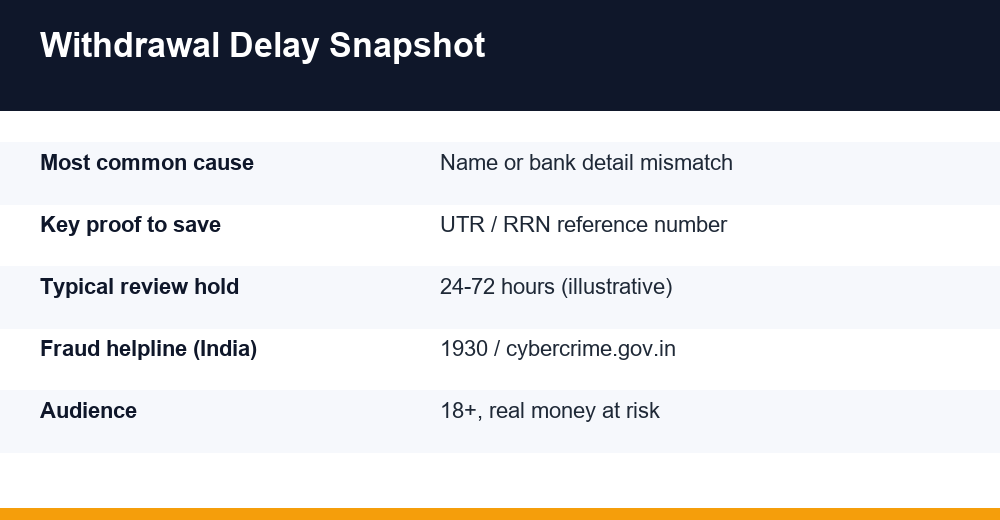
| 1 | Name / bank mismatch | Pending or rejected with vague reason | Resubmit with the exact name on your bank record |
| 2 | Unmet bonus turnover | Withdrawal blocked, balance locked | Check bonus terms; wagering shortfall must be cleared |
| 3 | Verification hold | Documents requested after you withdraw | Send clear, valid ID matching your account details |
| 4 | Duplicate request | Two entries, both frozen | Cancel one if possible; ask support to void the extra |
| 5 | Manual review queue | Pending with no message at all | Wait 1-3 working days before chasing |
| 6 | Large-amount check | Big win, extended processing | Expect extra review; keep all records |
| 7 | Bank-side delay | Marked completed, money late | Verify with the reference number at your bank |
| 8 | Operator cash-flow stall | Weeks of excuses, new deposit demands | Stop depositing; document and escalate |
Bonus turnover deserves its own note, because it is disputed most. Credit added to a wallet normally carries a wagering condition expressed as a multiple – the credited amount must be staked a set number of times before the linked balance becomes withdrawable. Until that is met, a payout can be blocked even though the wallet shows a healthy number.
Causes one to seven are fixable or self-resolving. Cause eight is the dangerous one: when an operator keeps inventing conditions – a “release fee”, a “tax deposit”, an “account upgrade” – the pattern matches what fraud-awareness bodies describe in payout scams. Any demand for a fresh deposit to release a withdrawal is a serious red flag. Genuine processing never requires you to pay money to receive money.
Can a Name Mismatch Block Your Payout?
Yes, and it is the single most frequent avoidable cause. Operators compare the beneficiary name you submit against the name registered on the receiving bank account. If your account says “Rahul K Sharma” and you typed “Rahul Sharma”, automated matching can fail and the request drops into manual review or outright rejection.
The same applies to UPI handles and wallets: a VPA registered to a different person – a sibling, a friend, a shop owner – will often be refused, because most platforms insist the payout account matches the account holder. Third-party withdrawals are also a classic fraud vector, which is why even honest operators block them.
How to clear a mismatch hold
- Open your bank app or passbook and copy the account holder name exactly as the bank records it, spelling and all.
- Compare it character by character with the name on your platform profile and the withdrawal form.
- If the platform profile name is wrong, ask support to correct it before resubmitting – do not just retry.
- Resubmit once, with matching details, and note the date and time of the new request.
- Avoid submitting repeatedly; stacked duplicates create a new delay of their own.
If you run cricket IDs, the same name-matching logic applies across every platform you use; the walkthrough in how cricket ID withdrawals are processed covers the step-by-step flow and where identity checks sit inside it.
Marked Completed but No Money Received: What to Check
This combination causes the most panic, but it has three mundane explanations and one bad one. The mundane ones: the operator marked the request completed when it entered their payment batch rather than when the bank confirmed it; the transfer is in normal interbank transit; or the money reached an account you were not watching.
The bad explanation is that the operator marked it completed without sending anything, hoping you stop asking. The way to tell the difference is the transaction reference number. Genuine bank transfers in India generate a traceable reference – a UTR for NEFT and RTGS, and an RRN for IMPS and UPI, which apps often display simply as a transaction or bank reference ID.
- Ask support for the UTR or RRN of the “completed” transfer, in writing.
- Check the exact receiving account you registered, including spelling of the account number.
- Give normal transit time – same day for most instant rails, up to one working day for batched transfers (illustrative, varies by bank).
- Quote the reference number to your bank and ask them to trace it.
- If support cannot produce any reference number for a “completed” payout, treat the claim as unverified.
A platform that genuinely sent your money can always produce this number. One that stalls, changes the subject, or sends images with the reference cropped out cannot. The full breakdown of what a UTR number proves in betting payouts explains how to read these references and use them with your bank.
Cancelling a Pending Withdrawal Request
Whether you can cancel depends entirely on how far the request has travelled. While a request is still pending – recorded but not sent to the bank – many platforms let you reverse it from the wallet or withdrawal screen, returning the amount to your balance. Once the status moves to processing or completed, cancellation is generally impossible because the money has entered the banking system.
Think carefully first. Some users cancel a slow request and resubmit, hoping to jump the queue. In practice that usually backfires: the new request starts at the back of the line, and rapid cancel-resubmit cycles can trigger duplicate-request flags that freeze both entries.
- Cancel only if the submitted details were wrong – wrong account, wrong amount, wrong method.
- Never cancel just to “refresh” a slow request; you lose your queue position.
- If the platform offers no cancel button, ask support in writing and keep the reply.
- After cancelling, confirm the amount actually returned to your balance before resubmitting.
One caution specific to colour-prediction and game apps: a few operators quietly treat cancelled withdrawals as fresh playable balance and nudge users to wager it again. Returned funds are your money; nothing obliges you to play them. Every round stays chance-based, with the platform holding the long-run edge.
Evidence Checklist Before You Contact Anyone
The difference between a complaint that gets resolved and one that gets ignored is usually documentation. Before you message support, call your bank, or report anywhere, spend ten minutes assembling a file. Every item below strengthens your position in any later dispute over a betting id withdrawal delay, and none of it can be gathered retroactively if the operator closes your account.
- Screenshots of the withdrawal request: amount, date, time, method, and status screen.
- Your wallet and transaction history inside the app, showing the deducted balance.
- Deposit proofs: bank statements or UPI receipts for money you paid in.
- Every support conversation: chat exports or screenshots including dates and agent names.
- The reference number (UTR or RRN) for any transfer the operator claims to have sent.
- Your bank statement for the receiving account across the relevant dates.
Store copies outside the app – email them to yourself or save them to cloud storage, since plenty of users lose everything the moment an account is suspended. If you later approach your bank or file a fraud report, this file turns “they are not paying me” into a checkable claim with dates, amounts and references.
Preventing the Next Betting ID Withdrawal Delay
Most stuck payouts are avoidable with ten minutes of preparation. The pattern across complaint threads is consistent: users whose details are set up correctly and who withdraw in predictable amounts rarely wait long, while users who improvise – new accounts, borrowed bank details, requests at odd hours – collect delays.
- Register with your own name, exactly as your bank records it, and use only an account or UPI handle in that same name.
- Complete identity verification before your first withdrawal rather than after, so the check does not land mid-payout.
- Keep one payout method and stay with it; switching methods often restarts verification from scratch.
- Note the platform’s minimum, maximum and daily payout limits, then request amounts that sit inside them.
- Avoid bonus credit you do not intend to wager, since linked turnover conditions can freeze otherwise clean balances.
- Send requests during working hours on weekdays, when manual review teams are actually staffed.
One habit matters more than the rest: keep your own log – date, amount, method, reference – for every request, because it is the only record that does not live on someone else’s server. And none of this changes the underlying maths. Outcomes are chance-based, the operator keeps a structural edge, and chasing a delayed payout with fresh deposits is the most expensive mistake here.
When to Escalate: Support, Bank, or Helpline
Escalation works best in stages, with a short wait between each. Jumping to the strongest option without evidence usually achieves nothing, while working through the stages with your documentation attached gets better results.
| Stage | When | Action |
|---|---|---|
| 1. Wait | First 1-3 working days | Normal queue time; chase nothing yet |
| 2. Support ticket | Day 3-4, still pending | One written message with evidence attached; request a reference number |
| 3. Follow-up | 48 hours after no reply | Repeat once, quoting the first ticket; note the pattern of replies |
| 4. Your bank | “Completed” but not credited | Give the UTR or RRN and ask for a trace on the transfer |
| 5. Fraud reporting | Deposit demands, closed account, weeks of stalling | Report with your evidence file to the national cybercrime channels |
If the pattern turns into fee demands, threats, or a vanished account, document everything and report it. In India, financial cyber fraud can be reported on the National Cyber Crime Reporting Portal or by calling the helpline 1930, which operates round the clock; reporting quickly matters because early reports improve the chance of money still sitting in a recipient account being held. Never share OTPs, PINs, or passwords with anyone, including callers claiming to be from a helpline or your bank.
Knowing what a functional support process looks like helps you judge a dysfunctional one; the breakdown of how Daman-style game support actually works sets out realistic response patterns and reply times.
Finally, if the stress or the losses behind a stuck payout are getting hard to carry, help exists. Tele-MANAS, India’s free national mental-health helpline, can be reached 24×7 on 14416 in multiple languages. This page describes payout processes for awareness only, for adults 18+, and does not endorse any platform.
Frequently Asked Questions
Why is my betting withdrawal taking so long?
Most often it is a manual review queue, a first-withdrawal verification check, or a mismatch between your submitted bank details and your account name. Weekends, large amounts, and bonus-turnover checks add more time. A betting id withdrawal delay of one to three working days is common; beyond a week with no clear reason, start documenting and escalate in writing.
Why is a withdrawal marked completed but money not received?
Either the operator marked it completed when it entered their payment batch, the transfer is still in interbank transit, or it reached a different account than you expected. Ask for the UTR or RRN reference in writing and have your bank trace it. If the operator cannot produce any reference for a completed payout, treat that claim as unverified.
Can I cancel a pending withdrawal request?
Usually yes, while the status is still pending and the money has not been sent to the bank. Many platforms offer a cancel option that returns funds to your wallet balance. Once the request shows processing or completed, cancellation is generally impossible. Avoid cancelling just to resubmit, since you lose your queue position and may trigger duplicate flags.
When should I contact support about a stuck withdrawal?
Wait one to three working days first, since manual queues are normal. Then send one written message with screenshots of the request, your transaction history, and a clear question: what is the status and the reference number. Follow up once after 48 hours. If replies turn into fee demands or endless excuses, stop depositing and consider reporting via 1930.