Deposit limits are the control everyone recommends and almost nobody sets properly. The problem is not that they do not work; it is that most of them are set in the one place where they can be undone in about fifteen seconds, by the version of you least likely to say no. A limit is only as strong as the delay between wanting to change it and being able to. That single idea ranks everything in this guide, from the account toggle that takes a minute to configure and a minute to reverse, through to the bank-level control that genuinely cannot be lifted today no matter how much you want it lifted.
Table of Contents
Why most deposit limits fail
The decision to set a limit and the decision to breach it are made by people in very different states. One is calm, planning, probably on a weekday. The other is mid-session, behind, and reasoning quickly.
A control that the second person can remove instantly is not a control. It is a note to self. This is why the measure of a limit is not where it is set but how long it takes to undo, and the strongest tools are the ones with a mandatory waiting period built in.
The ranking that results
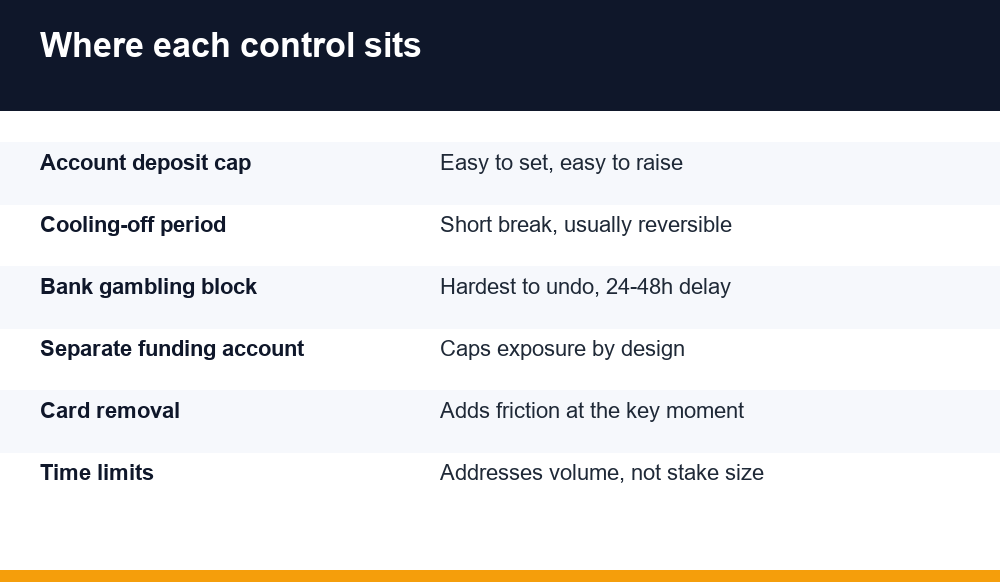
Controls that need another institution to lift them beat controls on the platform. Controls with an enforced delay beat controls that take effect immediately. And anything you can change while logged in and losing is the weakest category there is, however sensible the number looked when you chose it.
The account-level deposit cap
Most platforms offer daily, weekly and monthly caps in the responsible play or account settings. They are worth setting as a floor, with one important asymmetry to understand.
On a well-run platform, lowering a limit takes effect immediately while raising one is delayed, often by 24 hours or until the current period ends. That delay is the entire value of the feature, and it is the thing to check before relying on it.
If a platform applies an increase instantly, treat its deposit limits as advisory. The protection you wanted does not exist there, and you need something further up the chain.
- Set the monthly cap first, then the daily one underneath it
- Check in the settings how long an increase takes to apply
- Set it lower than feels necessary; it is trivial to live with and awkward to raise
- Re-check after any app update, since settings occasionally reset
Cooling-off and the reversal delay
A cooling-off period locks the account for a fixed stretch, typically 24 hours up to several weeks. It is a blunter instrument than a cap and more useful than it looks, because it removes the decision rather than limiting it.
The feature worth looking for specifically is whether the platform honours a withdrawal reversal block. Some allow a pending withdrawal to be cancelled and the money returned to the playable balance, which converts a decision to stop into a decision to continue at the worst possible moment. Platforms that make withdrawals irreversible once requested are doing something genuinely protective.
Where available, a reversal block is one of the highest-value settings on the whole account, and it is almost never promoted.
The bank-level block, and why it is different
Many banks and card issuers now offer a gambling transaction block, applied at the card level rather than the merchant level. It is the strongest widely available control for one reason: the platform cannot override it, and neither can you, immediately.
Most implementations include a cooling-off period of 24 to 48 hours before the block can be lifted, and some require contacting the bank rather than tapping a toggle. That delay is exactly the gap that matters, placed between the impulse and the ability to act on it.
The gaps worth knowing: blocks generally work on card transactions, and may not catch bank transfers or payments routed through an intermediary. Coverage varies by bank and by how a merchant is categorised, so it is worth testing rather than assuming.
If you set one thing from this page, set this one. It is free, it takes a few minutes in a banking app, and it is the only control on the list that the mid-session version of you cannot dismantle.
A separate account does most of the work
The structural approach beats the settings approach, and it needs no cooperation from any platform.
Fund anything of this kind from an account that holds neither salary nor savings, topped up deliberately on a schedule. The balance in that account becomes a hard ceiling that exists without anybody enforcing it, and the act of moving money into it is a separate, conscious decision made outside the session.
It also makes the figures visible. The most common reason people underestimate what they spend is that deposits leave from the same account as groceries and bills, where they disappear into the general flow. Isolated in one account, a month’s activity is a single number you cannot argue with.
This pairs naturally with the earlier point about payment methods. We covered the practical differences in our guide to deposit methods and what each one leaves behind, and the traceability argument there applies here too.
Removing the saved card
Small, unglamorous, and more effective than its simplicity suggests. A saved card turns depositing into a single tap; an unsaved one requires finding the physical card and typing sixteen digits.
Thirty seconds of friction does not sound like a safeguard, and in a calm moment it is not. Mid-session it is often enough for the impulse to pass, which is the only moment the safeguard needed to work.
The same logic applies to removing the app from the home screen, logging out at the end of every session, and not storing the password in the browser. None of these prevents anything. Collectively they convert a frictionless action into one requiring several deliberate steps, and deliberate steps are where reconsideration happens.
Time limits, loss limits and session reminders
Deposit limits control money going in. Two other categories control different variables, and on fast products the time one is arguably more important.
| Control | What it actually governs |
|---|---|
| Loss limit | Stops play at a set net loss. Useful, but after the loss. |
| Session time limit | Ends the session at a fixed duration regardless of result. |
| Reality check | Periodic pop-up stating elapsed time and net position. |
| Wager limit | Caps total staked, which on fast rounds is the real exposure. |
The reality check is the one people dismiss and then find useful. On a product with rounds measured in seconds, the ordinary sense of elapsed time disappears entirely, and a plain statement that ninety minutes have passed is frequently the thing that ends the session.
A wager limit deserves a mention too. With fast rounds and a recycled balance, total amount staked can be many times the amount deposited, so a deposit cap alone can leave actual exposure far higher than the number you set.
Reviewing what you actually spent
Every control above is prospective. The one retrospective habit worth building is checking the real number monthly, because memory is unreliable in a specific and predictable direction: wins are recalled in detail and deposits are not.
Most platforms provide an account statement showing deposits, withdrawals and net position over a chosen period. Pull three months rather than one, because a single month can be unrepresentative in either direction.
- Download or screenshot the statement rather than reading it on screen
- Record the net figure somewhere you will see it next month
- Compare it against what you would have guessed before looking
- If the gap between those two numbers is large, that gap is the finding
That last step is the whole exercise. The size of the discrepancy between what someone believes they spent and what the statement says is usually more informative than the spend itself, and it is the clearest signal that the controls on this page are worth putting in place properly rather than nominally.
Telling someone, and why it outperforms settings
Every control discussed so far is technical, and there is good reason to think the non-technical one works better than any of them.
Deposit limits, blocks and separate accounts all share a weakness: they are private, so the only person who notices them being dismantled is the person dismantling them. A limit that somebody else knows about behaves differently, because removing it now has a social cost as well as a technical one.
This does not require a difficult conversation or a confession. Telling a partner or a friend the monthly figure you have settled on, and agreeing to mention it if it changes, is enough. The mechanism is accountability rather than permission.
Where spending has already become a concern rather than a question, the same principle scales up: free, confidential support services exist in most countries, and the first conversation is typically about practical control rather than anything heavier. Reaching one early is considerably easier than reaching one late.
It is also worth saying that none of this is an argument against playing. It is an argument for deciding the number somewhere other than inside the session, which is the only place the decision was ever going to be made well.
A short note on timing. The best moment to put these in place is a day when none of it feels necessary, because that is the only time the decision is being made by someone with no stake in the answer. Setting a cap after a bad week tends to produce a number chosen in reaction, which is either punitively low and abandoned within a fortnight, or quietly generous enough to change nothing.
Pick the figure on an ordinary Tuesday, write it down, and treat any later argument for raising it as information rather than as a decision. The argument itself is the signal; whether it is a good argument is almost beside the point, because the calm version of you already considered the question without one.
Finally, review the whole arrangement twice a year rather than setting it once and forgetting it. Banks add and withdraw features, platforms redesign their settings pages, and an app update occasionally resets preferences without announcing it. A control you configured eighteen months ago and have not looked at since may no longer be doing anything at all, and the only way to know is to open it and check.
Frequently Asked Questions
How quickly can deposit limits be increased?
On a well-run platform, a decrease applies immediately and an increase is delayed, commonly by 24 hours or until the current period ends. If a platform raises limits instantly, the feature offers very little protection and you need a bank-level control instead.
Do bank gambling blocks actually work?
They are the strongest widely available option, because the platform cannot override them and lifting one usually involves a 24 to 48 hour cooling-off period. Coverage is not total: they generally apply to card transactions and may not catch bank transfers or payments through intermediaries.
What is the difference between a deposit limit and a wager limit?
A deposit limit caps money going into the account. A wager limit caps the total amount staked, which on fast rounds with a recycled balance can be many times the amount deposited. Where both are offered, the wager limit reflects real exposure more accurately.
Is a cooling-off period the same as self-exclusion?
No. A cooling-off period is a short, usually reversible break of a day to a few weeks. Self-exclusion is longer, harder to reverse, and often applies across multiple operators. Cooling-off suits a pause; self-exclusion is for stopping.
Why does a separate bank account help?
It turns the balance into a hard ceiling without anyone enforcing it, and it makes the monthly total visible as a single figure rather than scattered among normal spending. Most people underestimate what they deposit, and isolating it removes the guesswork.