If you have searched for the aviator game how it works, you have probably waded through pages of affiliate copy promising secret systems and sure-win tricks. This breakdown does the opposite and sticks to mechanics: the climbing multiplier, the crash point fixed by a random number generator before the round starts, and the maths behind the commonly cited 97% return figure. Every round is chance with a built-in house edge, real money is at risk, and the subject is for adults 18+ only.
Table of Contents
Aviator Game How It Works: The Basic Round Cycle
Aviator is a crash game. A small plane takes off on the screen, a multiplier starts at 1.00x and climbs as the plane flies. At some unpredictable moment the plane flies away – the round “crashes” – and the multiplier freezes. Anyone who cashed out before that moment has their stake multiplied by the figure shown at the instant they clicked. Anyone still in the round loses the stake entirely.
When people ask about the aviator game how it works, the honest answer fits in one line: you stake money, watch a number rise, and try to leave before a stop point you cannot see and did not influence. There is no flying skill, no steering, no level progression and no unlockable advantage. The aircraft is an animation layered over a single random number.
A typical round follows the same short cycle every time:
- A betting window opens for a few seconds; players place one or two stakes.
- The window closes and the plane takes off; the multiplier climbs from 1.00x.
- Players may press cash out at any moment while the plane is still flying.
- The plane flies away at the crash point; uncashed stakes are lost.
- The result is logged in the round history and the next betting window opens.
The whole cycle usually lasts well under a minute. That pace is a large part of what makes the format absorbing, and what makes it easy to lose track of time and money.
Terms You Will See On Screen
- Multiplier – what your stake would be multiplied by if you cashed out now.
- Crash point – the multiplier at which the round ends, decided before take-off.
- Cash out – the button that closes your position at the live multiplier.
- Auto cash out – a pre-set multiplier at which the system exits for you.
- Round history – the strip of past crash points shown along the top.
What Decides When the Plane Flies Away?
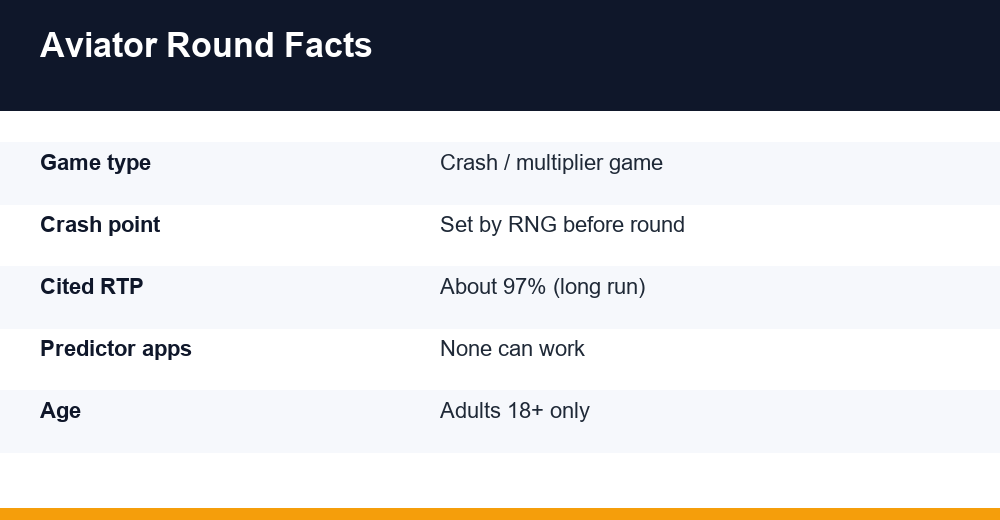
The crash point is produced by a random number generator (RNG) before the plane ever appears on screen. By the time you see the aircraft begin to climb, the round’s outcome already exists as a value on the operator’s server. The animation simply plays that value out in slow motion for dramatic effect.
This is the single most misunderstood fact about the format. The plane does not decide anything mid-flight. It does not react to how many players are in the round, how large the stakes are, how long you have been playing, or whether you cashed out of the previous ten rounds. Each round is an independent draw.
Two consequences follow directly from that design:
- Patterns in the round history – a run of low crashes, a long gap since a big multiplier – carry zero information about the next round.
- Nothing you do during a round, including waiting, hovering over the button or betting bigger, moves the crash point.
Low multipliers are common and high ones are rare, by design. A round can and does crash at 1.00x, meaning everyone still holding loses instantly regardless of reaction speed. That possibility is part of the maths, not a glitch or a sign of interference.
The belief that a big multiplier becomes “due” after a dry spell is the classic gambler’s fallacy. A run of 1.1x results makes the next round no more likely to reach 20x. Treating the history strip as a chart to read is the most expensive misunderstanding in the format.
Provably Fair Mechanics: Seeds, Hashes and Verification
The original version uses a provably fair system: a cryptographic method letting a player check, after a round, that the result was not altered once betting closed. Third-party descriptions outline the commonly cited process, though the exact distribution curve is proprietary.
In outline, the steps run like this:
- The server generates a secret seed and publishes a hash – a one-way fingerprint – of it before the round.
- A client seed is contributed by the first players to bet, or generated for a player’s session.
- The seeds and a round counter are combined and mapped to a crash multiplier.
- After the round, the server seed is revealed.
- Anyone can re-hash the revealed seed and confirm it matches the fingerprint published earlier.
If the hash matches, the outcome was locked in before anyone could see it. We cover the concept in full, including where it falls short, in our explainer on how provably fair games actually work.
What Provably Fair Does Not Mean
Verification proves a round was not rigged after bets were placed. It does not make the game beatable, reduce the house edge, or reveal anything about future rounds. A perfectly fair coin is still a coin – and this coin is weighted slightly toward the operator by design.
What RTP Means in the Aviator Game
RTP stands for return to player. The figure most widely cited for the original crash game is about 97%, with reviews noting it can differ by operator and version, so treat it as a reported figure rather than a guarantee. A 97% RTP means that across millions of rounds and all players combined, roughly 97 units are returned for every 100 staked. The missing 3 units are the house edge.
Understanding the aviator game how it works at the maths level means accepting what that gap implies: the average participant loses over time, and no cash-out habit changes the long-run expectation. Cash out early and you win small amounts often. Wait for big multipliers and you win large amounts rarely. The expected value stays negative either way.
The table below shows illustrative probabilities for a crash game with a 97% RTP, using the standard model where the chance of a round reaching multiplier m is roughly 0.97 divided by m. These are model figures for explanation only, not measured results from any platform or session.
| Target multiplier | Approx. chance round reaches it | Of 100 rounds (illustrative) |
|---|---|---|
| 1.50x | ~65% | ~65 rounds |
| 2.00x | ~48.5% | ~48 rounds |
| 5.00x | ~19.4% | ~19 rounds |
| 10.00x | ~9.7% | ~10 rounds |
| 50.00x | ~1.9% | ~2 rounds |
| 100.00x | ~1% | ~1 round |
Notice the symmetry: doubling your target roughly halves your chance of reaching it. That trade-off is the entire game. The small shortfall below 100% on every line is where the house edge quietly lives.
RTP is also a long-run average over enormous numbers of rounds, not a promise about an evening. A short session can land anywhere, and that variance is what makes losses feel like bad luck rather than arithmetic.
Cash-Out Timing: The Only Decision You Actually Make
Because the crash point is fixed before take-off, the single input a player controls is when to press cash out. Affiliate sites dress this up as “strategy”, but it is only a choice of where to sit on the same negative-expectation curve shown in the table above. Moving along that curve trades frequency of small wins against size of rare ones.
Two features often discussed alongside timing are worth understanding factually:
- Auto cash-out lets you pre-set a multiplier, say 1.80x, at which the system exits automatically. It removes reaction-time anxiety but does not change the odds by a single decimal.
- Dual bets allow two simultaneous stakes in one round, often with one on auto cash-out. This doubles the money exposed per round; it hedges nothing, because both stakes face the same edge.
Connection quality matters too. Your cash-out instruction travels to the server, and the server’s recorded moment is the one that counts. On a weak mobile connection a round can crash between your tap and the server registering it.
Staking systems are the other common misconception. Doubling a bet after every loss does not overcome a built-in edge. It only re-arranges when losses arrive, typically concentrating them into one large hit that can empty a balance within minutes.
Can Any App Predict Aviator Crash Points?
No. This is not a cautious “probably not” but a mathematical no. The crash point comes from an RNG and, in the provably fair version, is cryptographically committed before betting closes. For a predictor app to work it would need to break the hash function or read the operator’s server memory. Sellers on messaging apps and video platforms can do neither.
Anyone researching the aviator game how it works will meet these products within minutes of searching. Based on widely reported patterns, they fall into a few recognisable categories:
- Fake overlays that display random “signals” styled to look like insider data.
- Paid “VIP prediction” groups charging subscription fees for guesses anyone could make.
- APK downloads that install malware or harvest banking credentials and personal data.
- Upfront-fee schemes: pay to “activate” the predictor, after which the seller disappears.
A claimed accuracy rate of 90-100% is itself the giveaway. If someone could genuinely predict crash points, selling the method for a few hundred rupees would be the least profitable thing to do with it.
If you have paid a predictor seller or installed one of these apps and lost funds, act quickly. Report the incident through the National Cyber Crime Reporting Portal or call the 1930 cyber financial fraud helpline, and tell your bank at once about any compromised card or UPI access. Keep screenshots, transaction IDs and the seller’s contact details as evidence.
Crash-Game Clone Apps: Red Flags Breakdown
The plane animation is easy to copy, so the same visual appears inside a long tail of unknown apps and web wrappers. No named app is being labelled fraudulent here; these are simply observable warning signs readers can weigh for themselves.
- No working fairness check, or a “verify” button that produces nothing you can re-calculate.
- No identifiable operator – no company name, registered address or working support channel.
- Distribution only by direct APK file or a link forwarded in a chat group, with no listed developer.
- Requests for permissions unrelated to gameplay, such as SMS, contacts or accessibility access.
- Deposits routed to a personal account or a rotating set of UPI IDs rather than a consistent merchant.
- Withdrawal conditions that change after you win, or new “verification fees” demanded before payout.
A useful habit is to watch outgoing money rather than incoming promises. Smooth deposits prove nothing; the first withdrawal attempt reveals how an operation behaves. Treat any fee demanded to release your own funds as a serious warning sign.
Clone apps are also where recruitment pressure appears: referral links, group leaderboards and screenshots of supposed wins. Those screenshots cost nothing to fake, and the losing rounds are never the ones posted.
Aviator vs Colour Prediction Rounds: Same Engine, Different Skin
Is the plane game the same thing as a colour prediction game? Mechanically they are close cousins. Both run on short timed rounds, both resolve from a server-side random draw, and both are heavily promoted through social media. The differences are largely cosmetic rather than mathematical.
| Feature | Crash game (plane) | Colour prediction |
|---|---|---|
| Player input | Timing of cash-out | Pick colour or number before round |
| Outcome set | Before round, by RNG | At round end, server-side |
| Payout shape | Variable multiplier | Fixed odds per pick |
| Verification | Provably fair (original version) | Usually none |
| Round length | Seconds to about a minute | Typically 1-3 minutes |
The crash format at least shows the player a live multiplier and, in the original version, offers a fairness check. Many colour apps provide no verification whatsoever – the server simply announces a result. We break down what happens between the countdown and the announcement in how prediction rounds really work.
Marketing around both formats leans on the same myth: that a hidden pattern or algorithm exists for a clever player to crack. Our analysis of the colour prediction algorithm claims explains why chart-watching and sequence-tracking fail there for exactly the reason predictor apps fail here. Independent random draws have no memory, so there is no sequence to decode.
Realistic Expectations: A Pre-Round Reality Checklist
Strip away the animation and the hype and this is a fast, repeated wager against a fixed mathematical edge. Anyone choosing to engage with it should be able to tick every box below honestly first.
- I understand the crash point is decided before the plane takes off, and nothing I do changes it.
- I know the cited ~97% RTP means the operator keeps an edge over time, so the average outcome is a loss.
- I accept that round history, streaks and “due” big multipliers are meaningless.
- I will never pay for or install any predictor tool, because every one of them is worthless at best and malicious at worst.
- I am only using money I can afford to lose completely, and I am over 18.
The speed of the rounds is a risk factor in itself. Sixty or more rounds can pass in an hour, and small stakes compound far faster than they feel like they are compounding. Fixed time and money limits decided before the app opens are more useful than any in-round tactic, because they are the only limits the maths cannot erode.
If play has stopped feeling like a choice – chasing losses, hiding spending, borrowing to continue – that is a recognised warning sign, and confidential help exists. In India the Tele-MANAS mental health helpline is free and available 24/7 on 14416, and local counselling services can help too. Reaching out early costs nothing; the built-in edge, by contrast, never takes a round off.
Frequently Asked Questions
How does the aviator crash game actually work?
You stake money before take-off, a multiplier climbs from 1.00x as the plane flies, and you try to cash out before it flies away. The crash point is set by a random number generator before the round begins. Cash out in time and your stake is multiplied; miss it and the stake is lost. That is the aviator game how it works, with no skill element beyond timing your exit.
What decides when the plane flies away?
A server-side random number generator fixes the crash multiplier before the round starts. In the original provably fair version, a hashed server seed combined with player seeds locks the outcome in cryptographically before betting closes. Nothing during the flight influences it – not player numbers, not stake sizes, not your behaviour – and every round is independent of the ones before it.
Can any app predict aviator crash points?
No. The outcome is generated randomly and, in the original version, committed cryptographically before bets close, so prediction would mean breaking the hash function itself. Apps and channels claiming 90-100% accuracy are scams: fake signal overlays, paid guesswork groups, or malware-laden downloads. If you have lost money to one, report it on the cybercrime portal or call 1930.
Is aviator the same as a colour prediction game?
They are mechanically similar: short timed rounds resolved by a server-side random draw, with no skill influence on the result. The crash format pays a variable multiplier based on when you cash out, while colour games pay fixed odds on a pre-round pick. The original crash game offers a provably fair check; most colour prediction apps offer no verification at all.