Looking for provably fair games explained without the marketing gloss? This breakdown walks through server seeds, client seeds, nonces and hash verification in plain language, so you understand exactly what the technology proves. Just as importantly, it covers what provable fairness does not prove, because much of what you read about it online is written by platforms with something to sell.
Table of Contents
What Provably Fair Actually Means
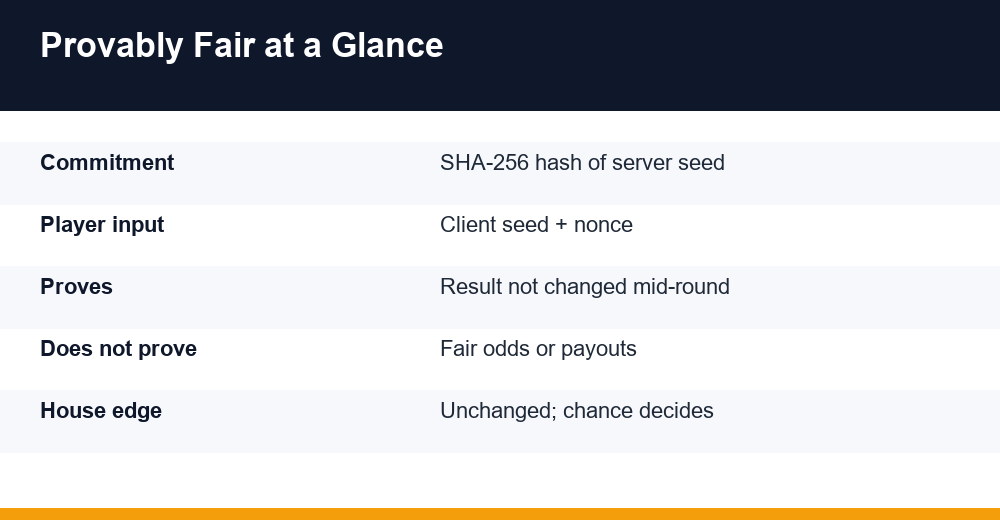
Provably fair is a cryptographic method that lets you check, after a round has ended, that the platform did not alter the result once your bet was placed. The platform commits to a secret value before the round, you contribute a value of your own, and the outcome is computed from both. Because the commitment is published in advance, the operator cannot quietly swap it later without the mismatch being detectable.
That is the whole claim. It is a narrow, technical one: the result was locked in before you played. It says nothing about whether the game’s odds are reasonable, whether the platform pays withdrawals, or whether the operation behind it is trustworthy. When you see provably fair games explained on casino blogs, that second half is usually missing, which is exactly why this page exists.
The term spread with crypto-style games such as crash, dice, mines and colour prediction, where results come from software rather than cards or wheels. With no dealer to watch, players wanted some way to check the software. Hash commitments gave them one, and marketing teams borrowed the phrase for its reassuring sound. For the broader picture of how software decides outcomes, our breakdown of the colour prediction algorithm covers how result generators work and why no pattern survives in genuinely random output.
- Provably fair means you can verify one specific round followed from pre-committed inputs
- It applies per bet, not to the game’s overall payout design
- It is a transparency feature, not a safety certificate or an endorsement
- Outcomes stay random and a house edge stays built in, verified or not
Provably Fair Games Explained Step by Step
The clearest way to get provably fair games explained is to follow one round from start to finish. Almost every honest implementation follows the same commit-and-reveal pattern, even where the exact formula differs from platform to platform.
- Commitment: before betting opens, the platform generates a secret server seed and publishes its SHA-256 hash, a fixed-length fingerprint that cannot practically be reversed.
- Your input: your browser or account supplies a client seed. On better implementations you can edit this value yourself before playing.
- The round runs: the game combines the server seed, your client seed and a nonce, a counter that increases with each bet, through a published function. An HMAC-SHA256 computation keyed on the server seed is the common choice.
- Reveal: when the seed pair is rotated, the platform discloses the original unhashed server seed.
- Verification: you hash the revealed seed and confirm it matches the fingerprint published at the start, then recompute the round result from the three inputs.
If the revealed seed hashes to the published fingerprint and the recomputed result matches what you were shown, the round was not manipulated after your bet. The same structure sits under crash titles; our explainer on the Aviator game and how it works shows this commit-and-reveal pattern applied to a multiplier curve instead of a dice roll.
Note one subtlety. The hash commits the server seed, but verification only becomes possible after that seed is revealed. Until rotation happens you are trusting the platform to reveal it eventually, and some never do. A fairness panel that shows hashes but no history of revealed seeds has told you nothing you can check.
Server Seeds, Client Seeds and Nonces
The three inputs each exist to remove a specific way of cheating. Understanding the job of each one makes the whole system click.
| Component | Who controls it | What it prevents |
|---|---|---|
| Server seed | Platform (hashed in advance) | Operator changing results after bets are placed |
| Client seed | Player (editable on good sites) | Operator pre-computing outcomes it knows you will receive |
| Nonce | Automatic counter | Replaying one result; makes every bet distinct |
| SHA-256 hash | Published before play | Operator swapping the server seed unnoticed |
The server seed is the platform’s secret randomness. Publishing its hash first is the commitment, much like sealing a written prediction in an envelope before the event. The client seed is your contribution. Because the operator cannot know what client seed you will set, it cannot pre-select a server seed that produces losing results for your specific inputs, provided you actually change the client seed from its default.
The nonce simply counts your bets under the current seed pair: bet one uses nonce 1, bet two uses nonce 2, and so on. That lets a single seed pair cover thousands of rounds, each with a distinct, recomputable outcome.
A practical habit follows. Where the feature exists, set your own client seed rather than accepting whatever was filled in for you. It is the only input in the system you control. It does not improve your chances, though; it only closes one door.
How to Verify a Round Result Yourself
Most accounts of provably fair games explained stop at the theory, so here are the actual steps. Verification needs no coding. Platforms with a genuine implementation provide a verifier page, and independent open-source verifiers exist that run in your browser, useful precisely because the operator did not write them.
- Before playing, copy the hashed server seed shown in the fairness panel and note your client seed and starting nonce.
- Play your rounds and record the results you were shown, along with each nonce.
- Rotate your seed pair, usually a button in the fairness settings. The platform must now reveal the previous unhashed server seed.
- Run the revealed seed through any SHA-256 calculator. The output must match the hash you copied in step one, character for character.
- Enter the server seed, client seed and nonce into a verifier. The recomputed result must match what the game displayed.
When the numbers do not match
Most mismatches are user error rather than cheating, and the causes are predictable: using the current server seed instead of the revealed previous one, an off-by-one nonce, the wrong separator in the input string, or the wrong mapping from hash output to result. Work through those before concluding anything.
Implementations differ in how they turn hash output into a game result. A dice game may take the leading hex characters of an HMAC output and convert them to a number between 0 and 99.99, while a crash game maps the same digest to a multiplier. The fairness page should state the exact method, including separators and byte order. If it does not, that vagueness is itself a warning sign, because verification is impossible without it.
If both checks pass, that round genuinely followed from the committed inputs. If the hash does not match, or the platform refuses to reveal old seeds, or the fairness page quietly disappears, you have learned something important, and it is better learned before larger sums are involved. Real money is at risk on these platforms either way, and verification does not change that.
What Verification Does Not Prove
This is the part the marketing pages leave out when they have provably fair games explained for you. Passing verification proves the result was not tampered with mid-round. It proves nothing beyond that. The game’s rules, odds and payout percentages were designed by the operator, and verification confirms those rules were followed, including the rules that guarantee the platform profits over time.
Does provably fair mean the game can be beaten?
No, and this is the most common misunderstanding by far. A provably fair game still carries a built-in house edge: payouts are set slightly below the true odds, so across many rounds the platform keeps a margin regardless of what any individual player does. Verification does not shift that margin by a fraction of a percent.
Outcomes remain pure chance. Past results do not influence future ones, and no amount of seed knowledge arrives in time to help you, because the server seed is only revealed after the bets it covered have already settled. Anyone selling a seed-reading system, a pattern tracker or a guaranteed-win method built on provable fairness is describing something the design makes impossible.
Fair process, unfavourable game
A game can be perfectly provably fair and still a poor proposition. Picture a coin-flip game paying 1.90x on a true 50/50 event. Every flip verifies flawlessly while the structure still returns roughly 95 paise per rupee staked over the long run, an illustrative figure rather than any platform’s number. The cryptography certifies the process, not the price.
Our piece on how prediction rounds really work walks through where that margin sits inside colour-prediction timers and payout tables, which is the number that actually decides long-run results.
- Verification cannot make a losing proposition a winning one
- It cannot confirm the platform will pay withdrawals
- It cannot vouch for how deposits or personal data are handled
- It cannot detect a dishonest engine hidden behind an honest-looking fairness panel
Provably Fair vs Independent Audits
Is provably fair the same as being independently audited?
No, and the difference matters more than any other point on this page. Provable fairness is a self-administered mechanism: the operator writes the code, generates the seeds, publishes the hashes and runs the verifier. An independent audit means an accredited external testing laboratory examines the random number generator, the game logic and the stated payout percentages, then reports on them against a published technical standard.
The two answer different questions. Provable fairness lets you check one bet at a time, which is genuinely useful. An audit validates statistical behaviour across millions of simulated rounds and, crucially, is carried out by someone who is not the operator. Neither replaces the other, and a fairness badge on its own is the weaker of the two signals.
There is also an implementation gap that no player can close. A fairness panel proves only what it actually covers. If the real betting engine does not use the published formula, if seeds are generated from something predictable such as a timestamp, or if only a subset of rounds pass through the verifiable path, the panel becomes theatre. You cannot inspect the server, so you cannot rule any of that out.
That trust gap is what external testing is meant to narrow. In short: provable fairness is a useful transparency tool sitting on top of a trustworthy operation. It is not by itself evidence that the operation is trustworthy.
Red Flags and Misleading Claims
Because the phrase sounds technical and reassuring, it gets borrowed by platforms that implement nothing of the kind. None of the signs below settles the question on its own, but each one should raise your guard considerably, and several together say a great deal.
- A “provably fair” badge with no fairness page, no visible hashes and no way to view or rotate seeds
- Hashes shown up front while old server seeds are never revealed, leaving verification permanently impossible
- No published formula explaining how the seeds map to a result
- Claims that provable fairness means you cannot lose, or that it delivers guaranteed honest profits
- Fairness language paired with pressure tactics: locked withdrawals, countdown timers, or agents on Telegram and WhatsApp pushing recharges
- A verifier that only runs on the platform’s own site and fails when the same inputs are checked with an independent tool
That last pairing is especially common on colour-prediction apps aimed at Indian users, where a technical-sounding fairness claim is used to make a recharge-and-withdrawal trap look credible. The fairness of individual rounds is beside the point if money never leaves the platform. Judge the withdrawal record first and the cryptography second.
Treat the fairness panel as one data point among several. A verified hash says nothing about whether support answers with specifics, whether withdrawal terms are stated plainly, or whether independent users describe payouts actually arriving.
If you have lost money to a platform that blocked withdrawals or vanished after deposits, act quickly. Call the cyber fraud helpline 1930, which operates around the clock, and file a complaint on the National Cyber Crime Reporting Portal. Fast reporting improves the chance of funds being frozen before they move on. Keep screenshots, transaction IDs, dates and amounts ready before you call.
Realistic Expectations Before Any Round
With provably fair games explained in full, the honest summary is short. The technology is real cryptography and, implemented properly, it genuinely prevents one specific kind of cheating: changing a result after your bet is placed. That is worth something. It is simply far less than the marketing implies.
What never changes: outcomes are decided by chance, the house edge is built into the payout table, and over enough rounds that edge wins. No verification step, seed setting or betting pattern alters the maths. These games are for adults aged 18 and over, played only with money you could lose entirely without consequence, and treated as paid entertainment rather than a way to earn.
Verification is best used as a filter rather than a strategy. If the hashes reconcile and seeds are revealed on schedule, one specific worry is off the table. If the panel is evasive, you have your answer cheaply.
If play is starting to feel compulsive, whether that means chasing losses, hiding spending or borrowing to recharge, support exists and reaching out works. In India, the government’s Tele-MANAS mental health helpline runs 24×7 on 14416, free of charge and available in multiple languages. Asking for help early is far easier than digging out later.
So use the fairness panel where it exists, set your own client seed, verify a handful of rounds, and let a failed check or a missing fairness page tell you everything you need to know about a platform. Just never confuse a verifiable process with a favourable one. The maths of the game, not the honesty of a single round, decides where the money ends up.
Frequently Asked Questions
What does provably fair actually mean?
It means the platform cryptographically commits to its randomness before you bet, by publishing a hash of a secret server seed. After the round, that seed is revealed so you can confirm the result followed from the committed inputs. It proves the outcome was not altered mid-round, nothing more. Odds, payouts and withdrawal behaviour are entirely separate questions.
How do server seeds and client seeds work?
The server seed is the platform’s secret random value, locked in advance by a published SHA-256 hash. The client seed is a value you supply, ideally one you edit yourself. Each result is computed from the server seed, your client seed and a nonce counting your bets. Because the operator cannot predict your client seed, it cannot pre-select outcomes against you.
Does provably fair mean the game can be beaten?
No. Verification confirms the process was followed, and that process includes a built-in house edge: payouts sit below the true odds, so the platform profits across many rounds. Outcomes stay pure chance, seeds are revealed only after bets settle, and no verification step improves your probability of winning by any amount at all.
Is provably fair the same as being independently audited?
No. Provable fairness is self-administered: the operator writes the code and runs the verifier, letting you check individual bets. An independent audit means an accredited external laboratory tests the random number generator and payout behaviour across millions of rounds. They answer different questions, and a fairness badge alone is not evidence a platform is trustworthy.