A wingo big small bet is the simplest market on a colour-prediction screen: instead of picking a colour or an exact digit, you predict whether the round’s result number lands in the lower range or the upper range. Most of what ranks online for this term is predictor-tool spam that never even defines the market, so this post does the opposite. It explains how the ranges are set, how the payout compares with colour and number bets, and why streak-reading and doubling systems cannot beat a chance-based game.
Table of Contents
What a Wingo Big Small Bet Means
Wingo is a timed prediction game. Every round, a counter runs down, stakes lock, and the platform declares a single result digit from 0 to 9. That one digit settles every market on the screen at once: the colour market, the exact-number market, and the big/small market.
A wingo big small bet asks only one question: will the result digit fall in the lower half of the range or the upper half? You are not predicting a colour, and you are not predicting which exact digit appears. You are backing a range of five digits out of ten.
Because the market covers half the digits, it feels like a near coin-flip, and that is exactly why it is the most heavily pushed option in messaging groups and predictor channels. A near 50/50 outcome makes any guess look like insight about half the time, which is perfect raw material for people selling “signals”.
The round structure matters too. Wingo screens usually run several parallel timers – commonly 30 seconds, 1 minute, 3 minutes and 5 minutes – and each timer is a separate game with its own results. We break down how those cycles work in our explainer on Wingo round timers. For this post, one fact is enough: the big/small outcome is just a property of the result digit, nothing more.
Worth saying plainly at the start: this is a chance-based money game with a built-in margin for the operator, real money is at risk on every round, and it is for adults 18+ only. Nothing below is a method for winning, because no such method exists.
- One digit (0-9) is declared per round and settles all markets
- Big/small is a two-range market covering five digits each
- The same digit also decides colour and exact-number outcomes
- Each timer (30s, 1min, 3min, 5min) is its own independent game
Which Numbers Count as Big and Which as Small
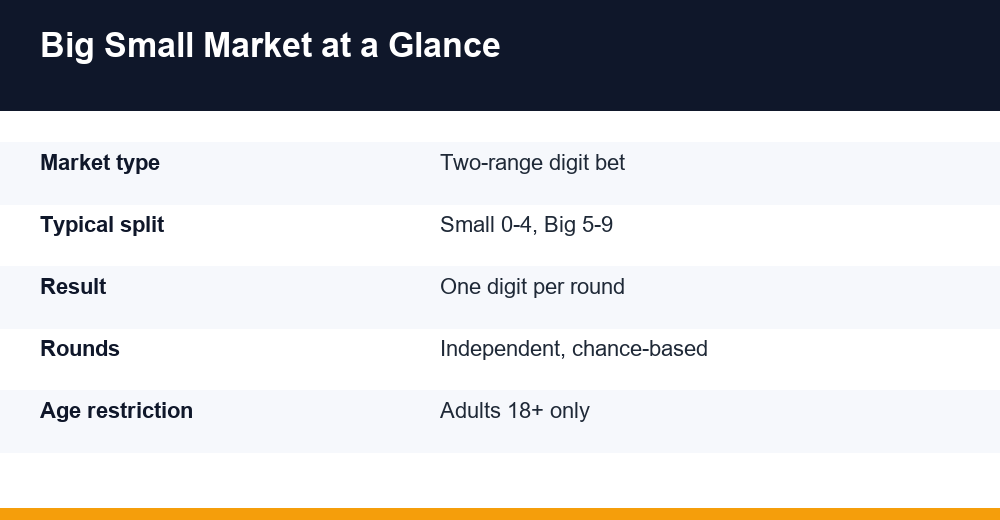
On most Wingo-style screens the split is simple: Small covers 0, 1, 2, 3 and 4, and Big covers 5, 6, 7, 8 and 9. Five digits on each side, no overlap, no digit left out. The shorthand used in app rule panels is usually a threshold: a digit of 5 or above settles as big, anything below 5 settles as small.
That said, the cut-off is set by the platform, not by any universal standard. Published descriptions of these games do not all agree – some write the small range as 1 to 4 and leave the treatment of 0 unstated, which changes nothing about the underlying maths but changes a lot about reading a result. Before a wingo big small bet makes sense to you, read the rules panel of the specific app, because two screens that look identical can settle the same digit differently.
This is one of the most common sources of “I was cheated” complaints that are really rule misunderstandings. A player assumes 5 counts as small because it sits in the middle, the app counts it as big, and the stake loses on a digit the player thought was a winner.
The typical mapping at a glance
| Result digit | Typical side | Share of digits |
|---|---|---|
| 0, 1, 2, 3, 4 | Small | 5 of 10 (50%) |
| 5, 6, 7, 8, 9 | Big | 5 of 10 (50%) |
Two practical checks before reading any result history: confirm where the app places the boundary digit, and confirm whether any digit triggers a special settlement rule. On many screens, 0 and 5 already carry special treatment in the colour market – the violet or mixed-colour rounds – and players wrongly assume that specialness carries over. On the typical setup it does not: 0 is simply small and 5 is simply big.
How Big Small Payouts Differ From Colour and Number Bets
The three main Wingo markets pay differently because they cover different slices of the ten possible digits. Big/small covers five digits, a straight colour covers roughly four or five depending on the app’s colour mapping, and an exact number covers exactly one.
The figures below are illustrative rather than quoted from any single operator. Payout tables are set per platform and can be changed, and some apps apply a fee on settlement. Treat the shape of the table as the point, not the exact multipliers.
| Market | What you predict | Digits covered | Illustrative payout |
|---|---|---|---|
| Big/Small | A five-digit range | 5 of 10 | Around 2x stake |
| Red/Green colour | The result’s colour | 4-5 of 10 | Around 2x (less on mixed digits) |
| Violet / special | A special digit (often 0 or 5) | 2 of 10 | Around 4.5x |
| Exact number | One specific digit | 1 of 10 | Around 9x |
Notice the pattern: the fewer digits a market covers, the bigger the multiplier – and in every case the multiplier sits a little below what the true odds would justify. Ten digits paying roughly 9x on an exact hit, or a half-the-digits range paying a shade under true double, is the house edge in plain sight. Over many rounds, that gap is why the operator keeps a percentage of everything staked regardless of who wins any single round.
So a wingo big small bet is not “safer” than a number bet in any meaningful sense. It wins more often and pays less, while the built-in margin stays exactly where it was. Frequent small wins simply make the drain slower and harder to notice.
- Wider market means higher win frequency and a smaller multiplier
- Narrower market means lower win frequency and a bigger multiplier
- Every market carries the same structural margin for the operator
- Win frequency is not the same thing as expected return
Is the Big Small Result Random in Each Round?
From the player’s side of the screen, yes – each round behaves as an independent chance event. The result digit is produced by the platform’s own software, players cannot observe or influence that process, and nothing about round 4051 is affected by what happened in round 4050.
Independence is the key word. A fair coin that lands heads five times is still 50/50 on the sixth flip; the coin stores no memory. The same logic applies to a digit generator: previous outputs do not shift future ones. We walk through the full lifecycle of a round – bet window, lock, result, settlement – in how prediction rounds really work.
There is an honest caveat worth stating. On a private app, players have no way to audit the number generation. You cannot verify fairness from the outside; you can only observe that the results are unpredictable to you. Both possibilities point the same direction, though: if the digits are fair, no exploitable pattern exists, and if an operator ever skewed them, it would not skew them in your favour.
Either way the practical conclusion is identical. Every wingo big small bet is best treated as an unknowable coin-style event where the payout is set slightly below true odds. That is the entire game, stripped of its decoration.
- Each round’s digit is generated independently of previous rounds
- Past results carry zero information about the next result
- Players cannot audit the generator on a private app
- Unpredictability plus a payout below true odds means a long-run margin for the operator
Do Several Small Results in a Row Mean Big Is Due?
No. This belief has a name – the gambler’s fallacy – and it is probably the single most expensive idea in colour-prediction games. If small has landed six times in a row, the chance of big on the next round is exactly what it always was, unmoved by the history above it.
Streaks feel meaningful because human brains are pattern-detection machines. Six smalls in a row looks like tension building toward a release. But in any long run of near 50/50 events, streaks of five, six or seven identical results are not anomalies – they are close to a mathematical certainty. Across a few hundred rounds you should expect to see them regularly.
Prediction channels exploit this instinct relentlessly. The result-history strip along the bottom of the screen keeps your eyes on past outcomes, and “trend reading” content teaches dragon patterns, alternating patterns and break points as if the digits were obliged to follow choreography. They are not. A pattern found in past random data describes what happened; it never forecasts what comes next.
The reverse belief – “small is hot, ride the streak” – fails for the same reason. Hot and due are both stories told about memoryless events. Whichever story you pick, the next round faces the same unchanged probability and the same built-in margin.
- A streak of identical results is normal in random sequences, not a signal
- The next round’s probability is identical after any streak of any length
- “Due” staking and “hot streak” staking are the same fallacy in opposite directions
- The history strip is a design feature that encourages pattern hunting
Why Doubling Systems Fail: The Maths Breakdown
The doubling system – usually sold under the name Martingale – is the most heavily promoted “strategy” attached to big/small. The pitch: back one side, and if you lose, double the stake and repeat until you win. When the win finally arrives it recovers all losses plus one base unit. On paper it sounds airtight. In practice it is a machine for converting many small wins into one catastrophic loss.
The problem is exponential growth. Starting at 10, a losing run doubles to 20, 40, 80, 160, 320, 640, 1,280. Seven straight losses – entirely routine in a near 50/50 game – means the eighth stake risks 1,280 to recover a net 10. One more loss and the required stake is 2,560, with 2,550 already gone.
| Loss streak | Next required stake (base 10) | Total already lost |
|---|---|---|
| 3 losses | 80 | 70 |
| 5 losses | 320 | 310 |
| 7 losses | 1,280 | 1,270 |
| 9 losses | 5,120 | 5,110 |
Two walls stop every doubling sequence. First, the wallet: the required stake grows faster than most balances can survive. Second, the platform: stake caps and wallet limits put a ceiling on how far anyone can double, and the sequence breaks the moment that ceiling arrives. When it breaks, the accumulated loss dwarfs all the tiny wins that came before.
Here is the quieter point the sellers never mention. Even with unlimited money and no caps, doubling would not change the expected value of a single round, because each individual stake still carries the same margin. A staking pattern rearranges when you lose; it cannot change whether you lose on average. Outcomes stay chance-based, and no system – doubling, tripling, Fibonacci, or anything named after a channel admin – alters that.
The same reasoning dismantles the softer variants: raise-after-win ladders, recovery sequences, “safe” half-doubling. They all reshuffle the same negative-margin rounds into a different order. The big/small market has one expected value, and the order the stakes are placed in does not touch it.
Predictor Tools and Recharge Traps: Red Flags Checklist
Search for big/small content and you will drown in “prediction tool V5” pages, hack APKs and VIP signal groups. None of them can work, for the reason covered above: independent rounds carry no exploitable signal. We dissect the whole genre in our post on the colour prediction algorithm myth, but the short version is that a predictor’s real product is you – your recharge, your referral, or your data.
Watch for these patterns around big/small content specifically. Any one of them is a reason to stop and verify before parting with money or installing anything.
- Accuracy claims – “95% sure shot” on a near 50/50 market cannot be sustained, and winning screenshots are trivial to fake or cherry-pick
- Paid VIP tiers where the “premium” signal is a coin-flip sold at a monthly fee
- Hack APKs that ask you to sideload an app – a common route to malware and stolen credentials
- Admins who post wins publicly and quietly delete losses, manufacturing a track record
- Groups pushing a specific recharge link or gift code, where the admin earns on your deposits
- Pressure to screenshot a recharge as “proof of seriousness” before signals arrive
- Withdrawal conditions that surface only once you try to take money out
A useful mental test: if someone genuinely held a method that beat a chance-based game, selling it to strangers for a few hundred rupees a month would be the least rational thing they could do with it. The business model only makes sense when the predictions are worthless and the income comes from subscriptions and referral commissions.
This section describes red flags so you can judge any app or channel for yourself; it does not accuse any named service of anything. But the pattern – impossible accuracy claims, deposit pressure, vanishing losses – repeats so consistently that it deserves a permanent place in your checklist.
Realistic Expectations and Where to Find Help
Here is the honest summary nobody selling predictions will offer. A wingo big small bet is a near coin-flip with a payout set slightly below true odds. In the short run anything can happen – that is what randomness means. Over many rounds the built-in margin grinds balances downward, and no range choice, streak read or staking pattern changes that direction.
Realistic expectations therefore look like this: any money staked should be money that can be lost without consequence, wins are temporary variance rather than evidence of skill, and the longer the play continues the closer the result drifts toward the operator’s margin. Real money is at risk, outcomes are chance, and these games are for adults 18+ only.
Two different kinds of help exist, and it matters to know which one applies. If money has been lost to a fraudulent app, a fake predictor subscription, or a wallet that refuses withdrawals, that is a fraud-reporting matter: in India the financial fraud helpline is 1930, and a complaint can be filed on the National Cyber Crime Reporting Portal. Reporting quickly improves the chance of freezing money that is still in transit.
If the difficulty is the playing itself – chasing losses, hiding recharges, borrowing to stake – that is a wellbeing matter, and free confidential support exists. In India, Tele-MANAS answers on 14416 (also 1-800-891-4416), round the clock and in multiple languages, under the Ministry of Health and Family Welfare. Talking to someone is not an admission of failure.
- Treat every stake as spent the moment it is placed
- Set a hard loss limit and a hard time limit before opening any app
- Never borrow, and never recharge to “win back” a loss
- Fraud losses: call 1930 and file on the national reporting portal
- Struggling with the play itself: Tele-MANAS 14416, free and confidential
Frequently Asked Questions
What does big and small mean in the Wingo game?
Big and small are the two sides of a range market. Each round ends with one result digit from 0 to 9, and a wingo big small bet predicts which half of that range the digit lands in. The same digit also settles the colour and exact-number markets, so you are simply backing five digits instead of one.
Which numbers count as big and which count as small?
On the typical setup, small covers the digits 0, 1, 2, 3 and 4, while big covers 5, 6, 7, 8 and 9 – five digits on each side. The boundary is defined by the platform, though, and published descriptions do not all agree, so always read the specific app’s own rules panel before interpreting any result.
Is the big small result random in each round?
From the player’s side, yes – each round’s digit is generated independently, and neither you nor the previous rounds influence it. You cannot audit a private app’s generator, but the conclusion is the same either way: there is no pattern to exploit, and the payout sits slightly below true odds, which is the house edge.
Do several small results in a row mean big is due next?
No. Rounds are independent, so a streak of small results carries no information about the next digit; this belief is the gambler’s fallacy. Streaks of five or more identical results are mathematically normal in any long random sequence. Backing “due” outcomes and riding “hot” streaks both face the same unchanged odds.