Live cricket odds movement looks chaotic from the outside: prices lengthen after two quiet overs, collapse the instant a wicket falls, then vanish from the screen for a few seconds after a big appeal. None of it is random. This breakdown explains, in plain language, the seven forces that reprice a cricket match ball by ball, so you can read what a live market is actually saying instead of guessing.
Table of Contents
What Drives Live Cricket Odds Movement
A live cricket market is a rolling answer to one question: what is the probability of each result right now? Every price on the screen is that probability expressed as a number. When the estimate changes, the price changes, and in cricket the estimate changes with almost every delivery.
If decimal and fractional formats still feel unfamiliar, it helps to read our plain-English piece on how cricket betting odds actually work first. The short version: a shorter price means the market rates an outcome as more likely, and every price carries a built-in margin for the operator, the house edge, so the numbers are never a perfectly fair mirror of probability.
Why do cricket prices change during a live match?
Before a match, pricing rests on squad strength, conditions, the toss and historical results at the venue. Once play starts, that static picture is replaced by a live one. Operators run models that re-estimate win probability continuously, fed by the score, wickets, balls remaining and conditions, and human traders adjust on top of the model when something the model cannot see happens, such as a batter visibly struggling with a hamstring.
Seven forces do most of the work, and the rest of this page takes each one in turn:
- Wickets, the single largest instant repricing event
- Required run rate against current run rate in a chase
- Overs and balls remaining, which decide how much any event matters
- Weather, dew and changing pitch behaviour
- The format, T20, ODI or Test, which sets the speed of swings
- The volume and direction of money being wagered
- Brief market suspensions after key moments, which reset prices
Nothing in that list is a secret or an inefficiency to exploit. It is simply how probability behaves in a sport where the situation can transform in one delivery. Understanding the mechanism makes live screens readable; it does not make outcomes predictable. Results still turn on chance, and money staked on them is genuinely at risk.
Wickets: The Single Biggest Price Shock
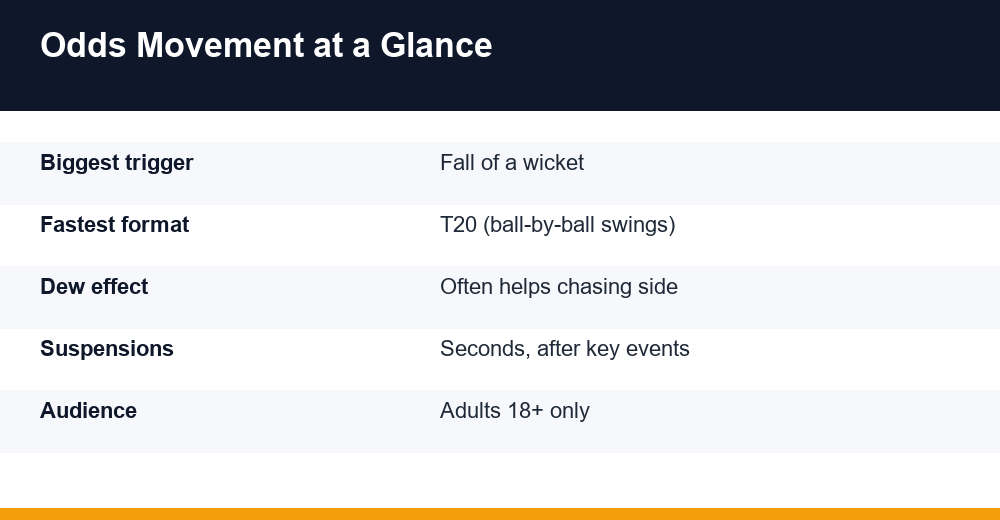
No single event moves a cricket market like a wicket. A dismissal removes a known quantity, a batter whose form, strike rate and matchup record were already priced in, and replaces them with uncertainty. The market reprices within seconds, and the size of the jump in live cricket odds movement depends on who fell and when.
A set opener caught on 70 in a tight chase is worth a far bigger swing than a tailender bowled in the final over of a one-sided game. Models and traders weigh several things at once:
- Who was dismissed, since a set, in-form batter costs more than a new arrival
- Who walks in next, a recognised batter or the start of the tail
- The partnership that was broken and how comfortable it had looked
- The phase of the innings, powerplay, middle overs or death overs
- The match situation, because a close chase amplifies everything
Wickets also tend to cluster. A new batter faces fresh pressure, the field comes in, and bowlers attack, so one dismissal raises the short-term probability of another. Markets reflect that: the price often moves further than the single wicket alone would justify, then drifts back if the new pair settles for a few overs.
The table below sketches how differently two superficially similar wickets can land. The directions are the pattern most viewers will recognise; the relative sizes are illustrative rather than measured figures.
| Situation | Who falls | Typical price reaction |
|---|---|---|
| T20 chase, 6 overs left, rate climbing | Set batter on 50 | Large, immediate move against the batting side |
| T20 chase, 6 overs left, rate climbing | Number eight on 2 | Smaller move, much already priced in |
| ODI first innings, over 15 | Opener | Modest move, long recovery time remains |
| Test, day one morning | Top-order batter | Gradual drift, draw price barely affected |
This is also why a dropped catch or a successful review can move prices almost as much as a wicket itself. The market had already partly priced the dismissal the instant the chance went up; the outcome of the moment decides which way the correction runs.
Required Run Rate: The Number That Rules a Chase
In the second innings of a limited-overs match, pricing largely collapses into one comparison: the required run rate against what the batting side is actually scoring. When the two track each other, prices stay calm. When they separate, prices move, and keep moving until something closes the gap.
A couple of quiet overs do slow, grinding damage. Each dot ball nudges the required rate up, which raises the pressure to take risks, which in turn raises the chance of a wicket. The market prices that feedback loop, not just the raw arithmetic of runs and balls left.
Wickets in hand act as the other half of the equation. A side needing 60 from 36 balls with seven wickets standing is in a very different position from one needing the same with two, and live prices separate those cases sharply even though the headline numbers match.
What makes prices swing hardest in a T20 chase?
Scarcity. A T20 innings has only 120 legal deliveries, so every ball is a meaningful slice of the total resource. The same three events that would barely register on day two of a Test can flip a T20 market inside a single over. A typical squeeze looks like this:
- The required rate creeps from 9 to 11 across two tidy overs
- The batting side’s price drifts out as the gap widens
- A set batter holes out trying to force the pace and the price jumps sharply
- A new batter hits two boundaries and much of the move reverses within minutes
That reversal is the part worth remembering. Live prices are not verdicts; they are running estimates that overshoot and correct constantly. Treating any single price as a judgement about which team will win misreads what the number is, and nobody watching the screen can turn that pattern into a reliable edge.
Weather, Dew and Overs Remaining
Time remaining acts as a multiplier on every other factor. A wicket with 40 overs left is a setback; the same wicket with four overs left can be decisive, because there is no time to recover. As an innings shortens, identical events produce progressively larger price moves.
Do weather and dew really affect live cricket prices?
Yes, and more than casual viewers expect. Dew is the clearest example in evening matches: as temperatures drop, moisture settles on the outfield and the ball, so bowlers struggle for grip, spinners especially, while the wet outfield quickens and the ball skids on. Conditions in the second innings can end up materially easier for batting than in the first.
Markets price this in before it happens. At venues with a known dew pattern, the side batting second is often rated more generously from the toss onward, and prices shift again in real time as players towel the ball between deliveries. Coverage of night tournaments in the United Arab Emirates reported chasing sides winning 17 of 25 evening games in one such stretch, a pattern specific to those venues and that season, so treat it as illustrative rather than a rule.
Rain works differently: it threatens revised targets, and the mere forecast of an interruption can feed live cricket odds movement before a single drop falls. Other condition-based inputs include:
- Cloud cover that helps swing bowling, particularly with a newer ball
- A pitch that slows, grips or breaks up as the match progresses
- Floodlights and the twilight period, which can briefly favour bowlers
- Ground size and altitude, priced in from the start but re-weighted late
- Wind direction, which affects which end the quicker bowlers prefer
None of these inputs is hidden. Broadcasters discuss dew, cloud and pitch wear openly, which is exactly why the market has usually absorbed them before a viewer at home thinks to act on them.
Format Differences: T20, ODI and Test Pricing
The same seven forces operate in every format, but the speed and amplitude of live cricket odds movement differ enormously between them. The shorter the format, the more each ball matters, and the more violently prices react.
| Format | Typical swing speed | What moves prices most |
|---|---|---|
| T20 | Very fast, ball by ball | Wickets, required rate, death overs |
| ODI | Moderate, over by over | Partnerships, middle-over squeezes, rate pressure |
| Test | Slow, session by session | Sessions won, pitch wear, weather and the draw |
Test markets carry a third runner, the draw, which changes the shape of everything. Poor weather can shorten a Test and shorten the draw price with it, even while neither team has done anything on the field. In limited-overs cricket there is no equivalent outcome; something must give before the overs run out.
ODIs sit in between. With 300 balls an innings, one over rarely transforms the picture, so moves build gradually through partnerships and squeezes rather than arriving as shocks. T20 is the opposite extreme: prices can swing dramatically across a handful of deliveries, because a handful of deliveries genuinely can decide the match.
This is worth knowing even if you never place a bet, because screenshots of dramatic odds swings shared on social media are usually just T20 markets doing what T20 markets do. The volatility is structural. It is not evidence that anyone posting it knew something in advance.
Does the Money Wagered Move the Price?
Yes. On-field events are the main engine of live cricket odds movement, but the flow of money is a genuine second force, and how it works depends on the type of market you are looking at.
A traditional bookmaker sets its own prices and manages liability. If money piles heavily onto one team, the operator may shorten that team’s price and lengthen the other side, partly to balance its book, even when nothing has changed on the field. That move reflects the operator’s risk position as much as the state of the match.
An exchange works differently: prices there are set by users backing and laying against each other, so every tick is supply and demand made visible. Our explainer on what a cricket exchange ID involves covers that peer-to-peer model in more detail, including why exchange prices on big matches often move a beat ahead of bookmaker prices.
Does the amount of money wagered move cricket prices on its own?
It can, within limits. On a heavily traded international fixture the weight of money is enormous and spread across thousands of participants, so one-sided flow tends to be absorbed quickly and event-driven moves dominate. On thin, low-liquidity markets the opposite holds: relatively small sums can push prices around noticeably, and the displayed price becomes a poor guide to anything.
That is one honest reason to be sceptical of anyone claiming a price moved because insiders knew something. Far more often the explanation is mundane: a model update, a liability adjustment, or a burst of recreational money after a boundary. Confident stories about hidden information are usually sales pitches rather than analysis.
Market Suspensions and Vanishing Prices
Few things confuse new viewers more than a market that locks the instant something interesting happens. The padlock icon or greyed-out price is a suspension, and it is a deliberate, routine part of how in-play markets operate.
Why do live markets suspend for a few seconds?
Because for a moment the price on screen is stale. When a batter skies a catch, the probability of each result has already changed, but the displayed number has not caught up. If the market stayed open, anyone acting in that gap would be transacting on a price that no longer matches reality. Operators lock the market, let the event resolve, reprice and reopen, usually within seconds.
Common triggers for a brief lock include:
- A wicket, until the dismissal and the incoming batter are confirmed
- A review, since the outcome is binary and the price impact is large
- A boundary check or a possible no-ball call
- The final over of a tight chase, when every ball is decisive
- A detected lag or fault in the operator’s data feed
Why do prices sometimes disappear entirely mid-match?
Longer disappearances usually mean larger uncertainty. Rain stoppages, an injury to a key player, a pitch inspection or a prolonged conference between umpires can keep markets closed for many minutes, because the eventual restart terms, revised overs and adjusted targets, are unknown. Some side markets are also withdrawn permanently once they stop making sense, such as an innings-runs line after that innings has ended.
In every case the logic behind live cricket odds movement is the same: no reliable price, no open market. A suspension is not a signal about which way the game is going, and reading one as a tell is a misunderstanding of what it is for.
Realistic Expectations and Red Flags
Everything above describes a repricing machine, not a prediction machine. Match outcomes remain a matter of chance, every price includes a margin for the operator, and real money staked on these markets is genuinely at risk. This explanation is for adults aged 18 and over, and it exists to describe how the numbers behave, not to encourage anyone to take part.
Understanding why prices move also makes certain sales pitches much easier to see through. Treat the following as warning signs rather than proof about any particular operator or group:
- Selling odds-movement signals, or claiming to read suspensions as insider tells
- Promising guaranteed profit from live swings, which no price mechanism can deliver
- Private groups pushing you to act fast before the market corrects
- Requests for deposits through personal UPI handles or informal agents
- Quoted prices that differ wildly from every mainstream operator’s screen
- Pressure to recruit friends or to top up after a loss to unlock a payout
No single item on that list proves a specific outfit is fraudulent, and it would be wrong to label one as such from the outside. But each is a recognised warning sign, and the combination of urgency with guaranteed-win language is the classic shape of a con. The same repricing logic applies across sports, so the same pitch often arrives bundled with football or tennis, which is worth remembering before anyone talks you into a multi-sport betting ID on the back of an unbeatable live strategy.
If you have lost money to an online financial fraud in India, act quickly: call the helpline 1930 and file the details on the government’s National Cyber Crime Reporting Portal. Speed matters, because early reporting improves the chance of transferred funds being held before they move on. Raise a dispute with your bank at the same time rather than relying on one channel.
And if betting itself has stopped feeling like entertainment, free and confidential support exists. Tele-MANAS, India’s national tele-mental-health service, is available around the clock on 14416, in a range of languages.
Read live prices as what they are, a crowd’s running and imperfect estimate of probability with a margin built in, and the drama on the screen becomes far less mysterious, and far harder for anyone to mis-sell to you.
Frequently Asked Questions
Why do cricket betting odds change during a live match?
Live prices track each team’s estimated probability of winning, and that estimate shifts with nearly every ball. Wickets, boundaries, dot-ball pressure, the required run rate, overs remaining and changing conditions all feed the calculation, so live cricket odds movement is continuous. A quiet over barely nudges prices, while a wicket or a dropped catch can transform them within seconds.
What makes odds swing the most in a T20 chase?
Scarcity of deliveries. With only 120 legal balls in an innings, each one is a large slice of the batting side’s total resource, so a wicket or a widening gap between the required and actual run rate produces outsized moves. Losing a set batter while the required rate is climbing usually causes the sharpest single swing of a chase.
Why do live betting markets get suspended for a few seconds?
Operators briefly lock markets when the displayed price is momentarily stale, for example while a catch is in the air, during a review, or while a dismissal and the incoming batter are confirmed. Suspending prevents transactions at an outdated number, lets the pricing model catch up, and the market reopens at a corrected price seconds later.
Does the amount of money wagered move cricket odds?
Yes, alongside on-field events. Bookmakers adjust prices to manage their liability when money flows heavily to one side, and on exchanges prices are set entirely by users backing and laying. On heavily traded international matches this effect is usually small and absorbed quickly, while on thin markets modest sums can move prices noticeably.