A UTR number in betting payment disputes is the single piece of evidence people are asked for most often, and the one they least know how to find. This breakdown explains what a UTR actually is, where it sits inside UPI and bank apps, and what it can and cannot prove when a deposit or a payout goes missing. It is written for adults aged 18+ as consumer information only, not as encouragement to stake money on anything.
Table of Contents
What a UTR Number Is in a UPI Payment
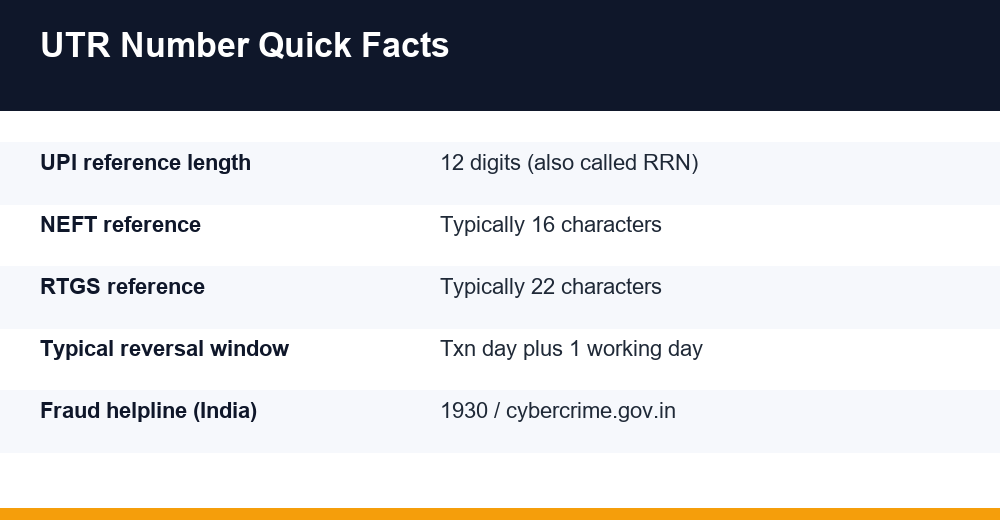
UTR stands for Unique Transaction Reference, a code the banking system generates for every interbank transfer in India. For UPI payments it is usually a 12-digit number, and depending on the app it may be labelled RRN (Retrieval Reference Number), UPI reference number, or simply UTR. The important property is that the sending bank and the receiving bank both log the same code against the same transfer.
That shared record is the whole point of it. Your payment app, your own bank, the receiver’s bank and complaint channels can all look up one transfer using one code, without having to trust anybody’s screenshot. It is the closest thing an ordinary user has to a neutral receipt for money that has already left the account.
Formats differ by payment rail, and that matters the moment someone asks you to “share the UTR”. A 12-digit numeric code points to UPI or IMPS, NEFT references are typically 16 characters, and RTGS references run to around 22. Those lengths are typical patterns rather than cast-iron rules, but a supposed UTR that looks nothing like any of them deserves immediate suspicion.
UTR compared with the UPI transaction ID
Payment apps also display a separate UPI transaction ID, a longer alphanumeric string created by the app itself rather than by the banking network. Banks trace payments by the numeric UTR or RRN, not by an app’s internal identifier. Sending the wrong one is easily the most common reason a support desk replies that your reference does not match any record on their side.
- UPI reference: usually 12 digits, fully numeric, sometimes shown as RRN
- NEFT: typically a 16-character alphanumeric reference
- RTGS: typically a 22-character reference
- IMPS: a 12-digit RRN, the same shape as a UPI reference
- The same code is visible to both the sender’s and the receiver’s bank
UTR Number in Betting Deposits and Withdrawals
Most informal cricket ID and colour-prediction platforms take deposits as plain UPI transfers into accounts controlled by an agent, then ask you to submit the payment reference so your wallet can be credited by hand. That is why the UTR number in betting deposits carries so much weight: it is frequently the only verifiable record linking your money to the account that received it.
The same logic applies in reverse. When a payout is supposedly “sent”, the platform should be able to hand you its reference so your own bank can confirm whether a matching credit exists at all. The deposit routes themselves, and why manual reference submission is a warning sign in the first place, are covered in our breakdown of how cricket ID deposits actually move.
Two points are worth stating plainly before going any further. These games are chance-based with a built-in house edge, so losses are the expected long-run outcome whatever the short-run result looks like, and real money is at risk from the moment it leaves your account. Everything on this page is consumer information for adults aged 18+ and is not an endorsement of any platform.
How to Find the UTR of a Transaction
Every major UPI app shows the reference inside the transaction detail screen. The only real friction is the label, which changes between apps and between app versions. The steps below work across Google Pay, PhonePe, Paytm and BHIM with minor wording differences.
- Open your UPI app and go to the transaction history or passbook section.
- Tap the specific payment you want to trace.
- Expand the details view and look for UTR, UPI reference number, or RRN.
- Copy the 12-digit number exactly, rather than retyping it from memory.
- Cross-check it against your bank statement or debit SMS before sharing it anywhere.
| Where to look | Label you will typically see | Notes |
|---|---|---|
| Google Pay | UPI transaction ID / UTR | Open the payment, tap to expand details |
| PhonePe | UTR | Transaction details screen, below the status |
| Paytm | UPI reference number | Tap the payment in history, view details |
| Bank app or statement | Ref no. / UTR / RRN | Shown against the debit entry |
| Bank SMS alert | UPI Ref | The 12-digit number inside the debit SMS |
Finding it in your bank statement
If the app view is unclear, download a mini statement or a PDF statement from your bank app. The reference usually sits in the narration or remarks column of the debit entry, sometimes buried inside a longer string such as UPI/123456789012/…, and the 12-digit block is the part you want. That illustrative string is a format example, not a real transaction.
If the reference is missing entirely
A payment still marked pending may not have a reference yet, because the network has not finished processing it. Wait for a final status instead of repeating the payment, which is how people end up paying twice. If a completed payment shows no reference at all in the app, your bank statement is the authoritative place to look.
Can a UTR Prove a Deposit Was Made?
A reference code proves exactly one thing: a transfer left your account and was processed by the banking system into some destination account. For a disputed deposit that is genuinely useful, because it stops an agent claiming the payment never happened. In practice the UTR number in betting complaints is the difference between an unwinnable argument and a traceable bank record.
What it does not prove matters just as much. It does not show that the receiving account belongs to the platform you believed you were paying, and it cannot compel anyone to credit your wallet balance. Crediting a gaming wallet is a manual, voluntary act performed by whoever controls that receiving account.
What a reference can and cannot establish
- Can: confirm the debit happened, with the date, time and amount
- Can: give your bank a hook to trace the beneficiary account in a complaint
- Cannot: prove the beneficiary was the platform, or that a wallet credit was owed
- Cannot: reverse the payment by itself, since a completed UPI transfer is not cancellable
That last point surprises people. UPI is designed as a push payment, so there is no chargeback button of the kind card users expect. Once a transfer completes successfully to a valid account, getting the money back depends on the receiver returning it or on an investigation reaching that account.
When the Bank Says the UTR Does Not Exist
Hearing that a reference “does not exist” sounds alarming, but there are three ordinary explanations to rule out before the worst one. You may have shared the app’s alphanumeric transaction ID instead of the numeric reference. The transfer may still be pending, so the receiving bank cannot see it yet. Or a single mistyped digit quietly broke the lookup.
The fourth explanation is the serious one: the number was never real. Fake payment screenshots carrying invented references circulate widely, and some operators send doctored payout confirmations to stall users asking where their withdrawal has gone. If a platform gives you a payout reference and your bank finds no matching credit after a working day, work on the assumption that nothing was ever sent.
That stalling pattern repeats across the same category of platform, and the sequence of excuses is remarkably consistent. The equivalent behaviour on the withdrawal side is set out in our look at colour-prediction withdrawal processes.
What to do, in order
- Re-copy the reference from the original transaction screen, not from a chat forward.
- Confirm which rail was used, since a 16-character NEFT code will not resolve as a UPI reference.
- Ask your own bank to search the reference from their side, as they can see more than the app shows.
- If the reference is confirmed non-existent and money is owed to you, treat every further “processing” message as stalling and move to a formal complaint.
One further trap deserves naming. Screenshot-generator tools can produce convincing fake payment screens complete with plausible reference numbers, correct fonts and realistic timestamps. Never accept an image as proof of payment in either direction. Only a reference your bank can match to an actual ledger entry counts for anything.
How Long to Wait Before Raising a Payment Dispute
UPI transfers normally settle within seconds, so there is rarely much waiting involved. Where a payer’s account is debited but the beneficiary account is not credited, the standard banking turnaround for an automatic reversal is T+1, meaning the transaction day plus one working day. If the money has neither arrived nor come back after that window, the transfer has stopped behaving normally.
Those timelines cover genuine payment faults inside the banking system. A platform that received your money and simply will not credit your wallet or release a payout is a different problem altogether, and no payment timeline obliges it to act, which is precisely why stalling can run for weeks. How that typically unfolds, and the standard excuses used, is dealt with separately in our piece on why betting ID withdrawals get delayed.
For a real payment fault, start with the complaint flow built into your UPI app, then escalate to your own bank. The UTR number in betting disputes is the first field every one of those channels asks for, so have it copied and ready before you call. NPCI, which operates UPI, also runs a public complaint channel on its UPI user complaint status page, which routes the complaint to the bank where you hold your account.
| Situation | Reasonable wait | Then do this |
|---|---|---|
| Debited, beneficiary not credited | 1 working day (standard reversal window) | Raise a complaint in the UPI app, then with your bank |
| Payment shows as pending | A few hours, up to 1 working day | Do not repeat the payment, wait for a final status |
| Platform says payout sent and shares a reference | 1 working day for the credit to appear | Ask your bank to verify the reference |
| Suspected fraud | Act immediately | Report through the cybercrime channels noted below |
When you do complain, submit everything at once: the reference, amount, date and time, the last four digits of your account, the receiver’s UPI handle, and screenshots of the payment and of any chat where the platform acknowledged receiving it. Complete first submissions get resolved faster than drip-fed ones, because each missing detail restarts the clock.
Building a Payment Record That Holds Up
A reference on its own answers one question. A short, organised record answers all of them, and it is far harder to wave away. Build it while the details are fresh, because payment apps age out of easy view and chat histories get deleted by the other side without warning.
Keep each item in one place, named by date and amount. The point is not volume but completeness: a package that lets a stranger reconstruct what happened without asking you follow-up questions is the one that moves fastest through any complaint channel.
- The 12-digit reference, copied as text rather than only as an image
- A screenshot of the payment screen showing amount, timestamp and receiver’s UPI handle
- The debit SMS or statement line from your bank
- Any chat where the amount, the UPI handle or the payout was acknowledged
- Dates and times of every promise made about a pending payout
Collecting this is not about chasing a win. It is the same record you would want for any transfer to a stranger, and the discipline of keeping it often makes the overall picture clearer than any individual transaction does. People who track the UTR number in betting deposits alongside what was actually credited usually discover the gap long before an argument starts.
UTR Red Flags and Stalling Patterns
Most reference-related trouble follows a handful of repeatable patterns. None of them proves that any particular platform is fraudulent, but each one shifts risk onto you, and together they describe how money tends to disappear. Asking for a UTR number in betting deposits is normal in a manual-credit setup; what surrounds the request is what deserves scrutiny.
- A different personal UPI handle or bank account for every deposit, a classic rotation pattern
- Wallet credited only after you send a reference screenshot to a WhatsApp or Telegram “agent”
- A verification fee, or any payment demanded before your own withdrawal is released
- Payout “confirmations” your bank cannot match to any incoming credit
- Pressure to deposit again because an earlier reference “was not received”
If money has actually been taken, speed matters more than anything else. In India, financial cyber fraud can be reported on the national helpline 1930 or at cybercrime.gov.in, and reporting quickly improves the chance of funds being held before they move on again. Verify any helpline number before relying on it, since contact details do change.
If the losses themselves have become the bigger problem rather than one disputed payment, free and confidential support exists for that conversation, including Tele-MANAS on 14416 in India. Reaching out early is a practical step, not an admission of anything.
Keep the wider picture in view as well. No amount of payment-tracing skill changes the underlying arithmetic: outcomes are random, the operator holds the edge, and a reference code can only tell you where your money went, not bring back what the odds were always positioned to take. This page is for adults aged 18+ and exists to help people protect themselves, not to recommend playing.
Frequently Asked Questions
What is a UTR number in a UPI payment?
UTR stands for Unique Transaction Reference, the code banks assign to every interbank transfer. For UPI it is usually a 12-digit number, also labelled RRN or UPI reference number inside payment apps. Both the sender’s and the receiver’s bank log the same code, which is why it works as neutral proof that a transfer was actually processed, whatever either party claims afterwards.
Can a UTR number prove my deposit was made?
Partly. A valid UTR number in betting disputes proves the transfer left your account and reached a beneficiary account, and your bank can confirm the debit, the amount and the timestamp. It does not prove the account belonged to the platform, and it cannot force anyone to credit a gaming wallet. Pair it with a screenshot showing the receiver’s UPI handle and amount.
What if the bank says the UTR does not exist?
First check that you shared the numeric reference rather than the app’s alphanumeric transaction ID, and that no digit was mistyped. If the number genuinely resolves to nothing and it came from a platform as proof of a payout, a fabricated confirmation is the likeliest explanation. Treat further processing excuses as stalling and complain formally to your bank.
How long should I wait before raising a payment dispute?
Very little. UPI normally settles in seconds, and the standard turnaround for reversing a debit where the beneficiary was not credited is the transaction day plus one working day. If nothing has returned or been credited after that, raise a complaint in your UPI app and with your bank. For suspected fraud in India, report immediately via 1930 or cybercrime.gov.in.