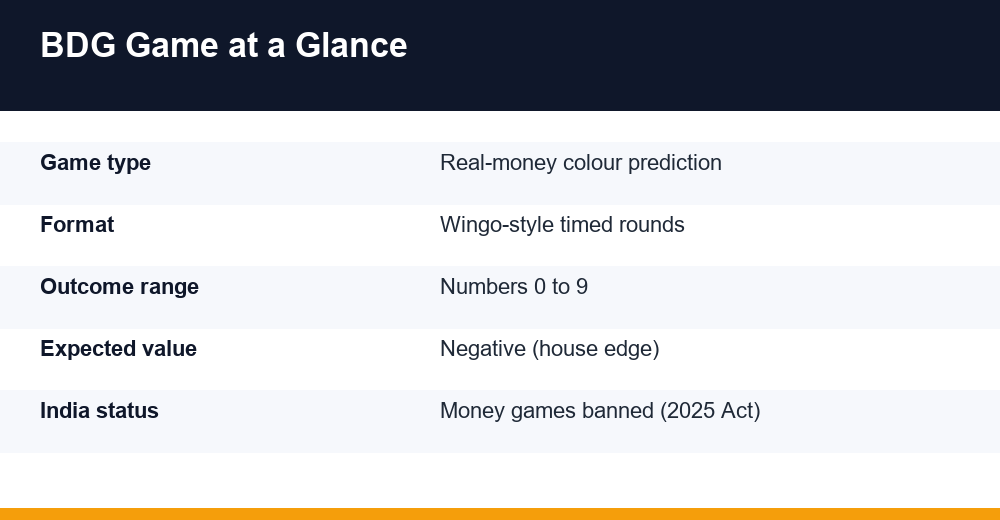
Colour-prediction apps look simple: pick green, red or violet, wait a few seconds and see what lands. Underneath that simplicity sits a fixed set of rules and some fairly blunt maths. This piece walks through how a round works and where the house edge sits. It is an explainer, not an invitation to play: real money is at risk, these apps are for adults aged 18 and over only, and online money games are now banned in India.
Table of Contents
Every Round Runs on a Fixed Timer
Unlike a cricket match that stretches over hours, Big Daddy Game, usually shortened to BDG, packages very short, repeating rounds that settle in minutes or less, which is exactly why the format deserves a careful look.
In the Wingo-style lobby, rounds are grouped by length, with 30-second, 1-minute, 3-minute and 5-minute rooms commonly reported. A one-minute room can produce dozens of paid decisions per hour. We cover the countdown and lock-out window in more detail in our guide to how Wingo round timers work.
- Period number: a unique ID for each round, used to check results later.
- Countdown: the open window for placing a prediction.
- Lock-out: the final seconds when entries close.
- Result: a single number from 0 to 9 that settles every bet type.
That pace changes how decisions feel. With seconds between rounds, there is little time to pause or decide to stop. Rules screens differ between apps and can change, so treat these timings as typical rather than guaranteed.
How Numbers Become Colours
The heart of every round is a single digit. Colours are not drawn separately; they are derived from that digit using a fixed map.
In the common Wingo layout, odd numbers are green and even numbers are red, with two exceptions. The number 0 counts as both red and violet, and the number 5 counts as both green and violet. Big and Small split the digits into 5 to 9 and 0 to 4.
| Result number | Colour(s) | Big / Small |
|---|---|---|
| 0 | Red + Violet | Small |
| 1, 3 | Green | Small |
| 2, 4 | Red | Small |
| 5 | Green + Violet | Big |
| 6, 8 | Red | Big |
| 7, 9 | Green | Big |
Green covers five of ten numbers, red covers five and violet only two. If outcomes are evenly random, each digit has a 1-in-10 chance, and the colour odds follow directly. One information site sets out its own version of these mechanics in a BDG Game colour prediction guide. Whichever guide you read, the in-app rules screen is the only version that governs settlement.
Payouts Sit Below Fair Odds
Colour-prediction apps display a multiplier for each bet type. The figures below are widely reported for Wingo-style games but could not be verified in an official rules document, so treat them as illustrative.
| Bet type | Winning numbers | Chance (if uniform) | Typical multiplier | Fair multiplier |
|---|---|---|---|---|
| Green | 1, 3, 5, 7, 9 | 50% | 2x (1.5x on 5) | 2x |
| Red | 0, 2, 4, 6, 8 | 50% | 2x (1.5x on 0) | 2x |
| Violet | 0, 5 | 20% | 4.5x | 5x |
| Single number | One digit | 10% | 9x | 10x |
| Big / Small | Five digits | 50% | 2x | 2x |
The fair multiplier is 1 divided by the chance of winning. Violet should pay 5x but pays 4.5x; a single number should pay 10x but pays 9x. That gap is the operator’s margin.
Green and red look fair at 2x, but they are not. When the result is 5 or 0, the colour that shares a slot with violet usually pays only 1.5x, which quietly tilts the maths against the player. Many apps also take a service fee on each entry, often reported at around 2%, so a ₹100 entry may only put ₹98 into play.
The House Edge in Plain Numbers
Expected value is the average result of a bet repeated many times. It shows which way your balance drifts, and on every bet type we checked, the drift is downward. The examples below are illustrative: they assume each digit is equally likely, a ₹100 entry, a 2% fee leaving ₹98 in play, and the typical multipliers above.
Example: ₹100 on Green
- Win on 1, 3, 7 or 9 (40% chance): ₹98 × 2 = ₹196 returned.
- Win on 5 (10% chance): ₹98 × 1.5 = ₹147 returned.
- Lose on any red number (50% chance): ₹0 returned.
- Average return: (0.4 × 196) + (0.1 × 147) = ₹78.40 + ₹14.70 = ₹93.10.
That is a loss of roughly 6.9% per bet.
| Bet (₹100, illustrative) | Average return | Average loss per bet |
|---|---|---|
| Green or Red | ₹93.10 | ₹6.90 |
| Violet | ₹88.20 | ₹11.80 |
| Single number | ₹88.20 | ₹11.80 |
| Big / Small | ₹98.00 | ₹2.00 |
A few rupees sounds small until you factor in speed. In a one-minute room, thirty ₹100 entries in half an hour could expose ₹3,000, with an expected loss of around ₹200 on green or red. Short sessions swing widely thanks to variance, which is why some players remember big wins, but over hundreds of rounds the house edge takes over.
Why Past Results Tell You Nothing
Every lobby shows a strip of recent results, and many players study it for streaks. It is useless for prediction. If each round is generated independently, the previous ten greens have no influence on round eleven. Believing otherwise is the gambler’s fallacy: a fair coin that lands heads five times is still 50/50 on the sixth toss.
- Trend charts describe the past; they cannot change the odds of the next draw.
- Doubling strategies do not remove the house edge; they raise the size of the eventual loss.
- Paid “prediction” groups on Telegram or WhatsApp cannot know an independent outcome in advance.
- Short winning runs are normal variance, not evidence of a working system.
Players also cannot audit an app’s result engine, so there is no independent proof that outcomes are fair at all. That is one more reason not to trust any pattern or promised “trick”.
Example: Why Doubling Fails
Consider an illustrative doubling plan on red, starting at ₹10 and doubling after each loss. After six straight losses the next stake is ₹640, and the total already lost is ₹630. A win at that point recovers the losses and nets just ₹10 before fees. Six losses in a row on a roughly 50% bet sounds unlikely, but in a one-minute room you play sixty rounds an hour, so long losing runs turn up far more often than intuition suggests. When one arrives, the stake either hits the app’s maximum bet limit or exceeds what you can afford, and the system collapses.
Before reading any chart or tip, it helps to ask three plain questions: does this change the chance of the next digit, does it change the multiplier, and does it change the fee? If the answer to all three is no, the tip cannot change your expected loss.
The Legal Position in India
India’s Promotion and Regulation of Online Gaming Act, 2025 received presidential assent in August 2025. Gazette notifications issued on 22 April 2026 brought the Act and the accompanying Promotion and Regulation of Online Gaming Rules, 2026 into force from 1 May 2026.
The Act prohibits offering, advertising or promoting online money games, whether based on chance, skill or both, and bars banks and payment systems from processing related transactions. E-sports and social games without real-money stakes are treated separately.
A real-money colour-prediction product falls squarely within what the Act targets. Offering such games can attract imprisonment of up to three years, a fine of up to ₹1 crore, or both; advertising carries separate penalties, and enforcement can include blocking access. For exact provisions, read the official text of the Act and the 2026 Rules on India Code.
This section is general information, not legal advice. For a specific question, consult a qualified Indian lawyer.
Warning Signs and Where to Get Help
We have no evidence to label this platform a scam. But the wider colour-prediction market has well-known warning signs that apply to any app, including clone sites with similar names.
- Promises of guaranteed or “fixed” wins, or claims that colour prediction can be a regular income.
- Pressure to recharge quickly through personal UPI IDs or unfamiliar payment handles.
- Withdrawals that stall behind new fees, “tax” payments or extra turnover demands.
- No clear company name, address, grievance contact or published rules.
Bonuses deserve particular care, because many apps attach wagering requirements before any bonus-linked money can be withdrawn. We explain how these conditions typically work in our breakdown of Daman Game bonus and referral terms, and the same reading applies to most similar apps. Whatever the app, never share an OTP, UPI PIN or banking password with anyone claiming to be support staff, and keep screenshots of payments and chats.
If you believe you have been defrauded online, report it at the National Cyber Crime Reporting Portal (cybercrime.gov.in) or call the national cybercrime helpline 1930 as soon as possible.
If gaming is affecting your sleep, money, work or relationships, you can call Tele-MANAS on 14416 (or 1-800-891-4416), the government’s free mental-health helpline.
To sum up, colour prediction is a fast, fee-bearing game of chance with a built-in house edge, no reliable prediction method and, since May 2026, no lawful place as a real-money product in India. It is strictly for adults aged 18 and over. Understanding the maths is useful; acting on it with real money is not, and the safest stake remains no stake at all.
Frequently Asked Questions
How is the winning colour decided in a colour-prediction round?
Each round produces one number from 0 to 9, and the colour is derived from it. In the common Wingo layout, odd numbers are green, even numbers are red, and 0 and 5 also count as violet. Always confirm the exact mapping in the app’s own rules screen.
Can studying past results help predict the next colour?
No. If each round is generated independently, earlier results have no effect on the next one. Expecting a colour to be ‘due’ is the gambler’s fallacy. Trend charts, doubling systems and paid prediction groups cannot remove the built-in house edge.
Is there a house edge in colour-prediction games?
Yes. Typical multipliers pay less than fair odds, for example 9x on a 1-in-10 number and 4.5x on a 1-in-5 violet. With a 2% entry fee in our illustrative example, a ₹100 bet on green returns about ₹93 on average.
Is it legal to play in India?
India’s Promotion and Regulation of Online Gaming Act, 2025, in force from 1 May 2026, bans online money games and their advertising and promotion. Real-money colour prediction falls within that scope. This is general information, not legal advice; consult a qualified lawyer for specifics.